Why Commercial Construction Management Drives Project Success
Commercial construction management is the comprehensive coordination of building projects from initial concept through final completion, ensuring they stay on time, within budget, and meet quality standards. Here’s what you need to know:
Key Components:
– Planning & Design Coordination – Feasibility studies, permits, team assembly
– Cost Management – Budgeting, estimating, financial tracking, change order control
– Schedule Oversight – Timeline development, milestone tracking, resource allocation
– Quality Control – Inspections, compliance monitoring, standards enforcement
– Risk Mitigation – Safety protocols, contingency planning, problem resolution
As one industry expert noted: “Commercial construction can be a large-scale project with many moving parts and problems that need solving.” This reality makes effective management crucial.
The numbers tell the story. Construction managers held 520,900 jobs in 2023, with employment projected to grow 9% through 2033. The median annual wage reached $106,980 in 2024, reflecting the high value these professionals bring to complex projects.
Commercial construction projects act as major catalysts for economic growth. Unlike residential work, they involve stricter building codes, multiple stakeholder groups, and significantly larger budgets. A typical commercial project averages $17.8 million in value compared to $13.4 million for projects without professional construction management.
The difference between success and costly failure often comes down to having an experienced construction manager who can coordinate architects, engineers, contractors, and suppliers while keeping the owner’s interests front and center.
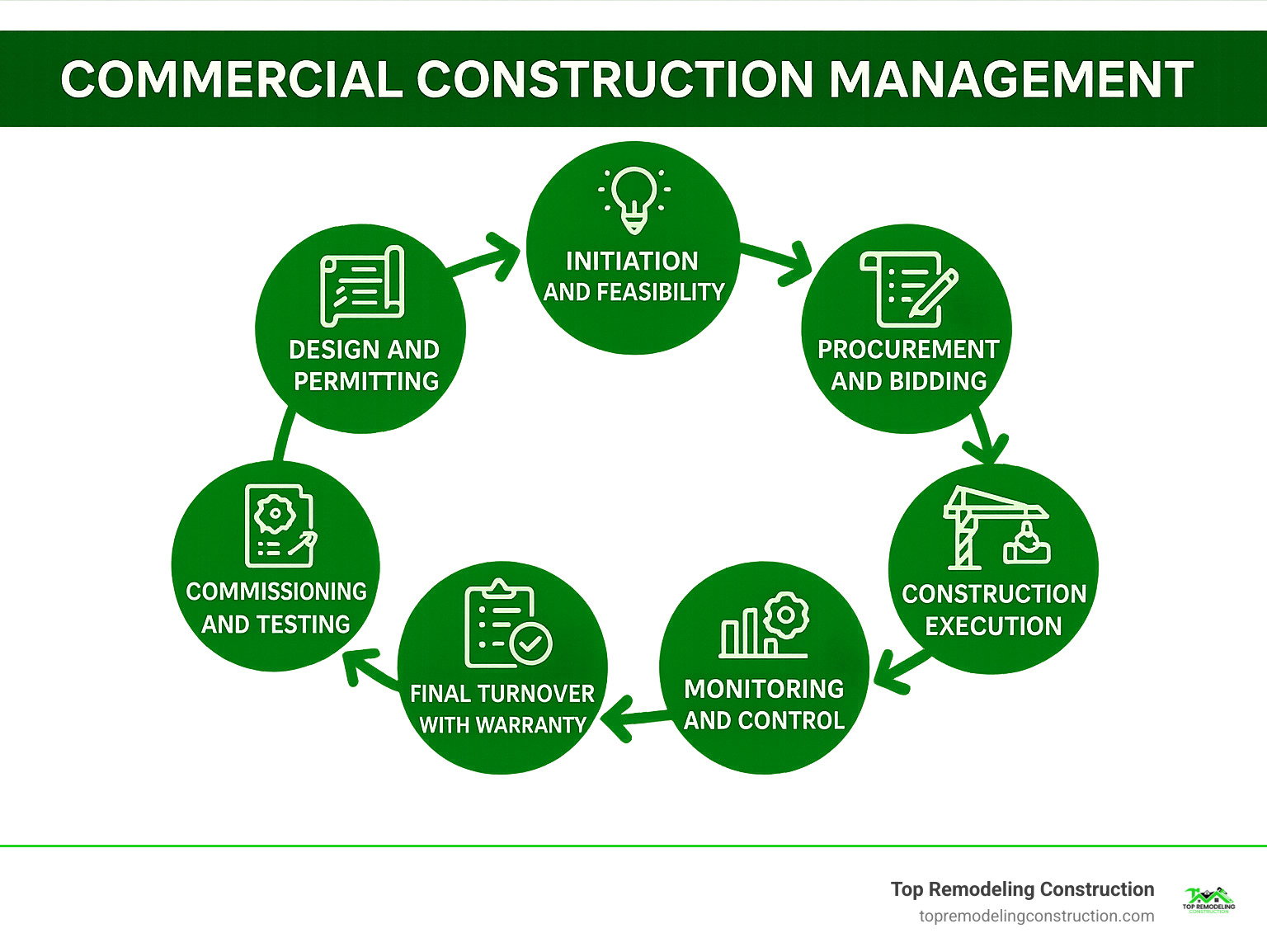
Quick look at commercial construction management:
– commercial construction business
– commercial construction cost estimator
– commercial construction financing
What Is Commercial Construction Management?
Picture a symphony orchestra preparing for a major performance. The conductor stands at the center, coordinating dozens of talented musicians, each with their own specialty. That’s exactly what a commercial construction manager does on a building project.
Commercial construction management is the art and science of bringing together architects, engineers, contractors, and suppliers to create something amazing. It’s about making sure everyone plays their part at the right time, in harmony with the overall vision.
The Construction Management Association of America (CMAA) has identified 120 core responsibilities that fall into seven main categories. That might sound overwhelming, but it really shows how comprehensive this field is. Every detail matters when you’re coordinating a multi-million dollar project.
What makes commercial construction management special is its focus on owner advocacy. While contractors concentrate on getting their specific work done, construction managers keep the big picture in mind. They’re always asking: “What’s best for the project owner?” This means watching the budget like a hawk, keeping timelines on track, and making sure quality never takes a backseat.
The difference between commercial and residential work is like comparing a major league baseball game to a backyard catch. Both involve throwing a ball, but the complexity levels are worlds apart.
| Commercial Construction Management | Residential Construction Management |
|---|---|
| Multiple stakeholders (owners, architects, engineers, city officials) | Fewer stakeholders (homeowner, contractor, maybe architect) |
| Steel and concrete construction requiring stricter codes | Timber frame construction with more relaxed regulations |
| Sprinkler systems and complex MEP requirements | Basic electrical and plumbing systems |
| Budgets typically $1M+ with formal procurement processes | Smaller budgets with simpler purchasing |
| Longer timelines with phased construction | Shorter, more straightforward timelines |
| Commercial liability and bonding requirements | Standard residential insurance coverage |
How Commercial Construction Management Differs From General Contracting
The biggest difference comes down to timing and perspective. Construction managers jump into projects during the design phase, when there’s still time to influence major decisions. They can suggest cost-saving alternatives, spot potential problems before they become expensive headaches, and help shape the entire approach.
General contractors typically enter the scene after the design is locked in. At that point, many of the most important decisions have already been made. It’s like being invited to help plan a dinner party after the menu has been printed and the guests have been seated.
Payment structures tell another part of the story. Construction managers work on a fee-for-service basis, earning their compensation regardless of how much the project costs. This keeps their interests aligned with the owner’s goals. General contractors, on the other hand, make money from the difference between their contract price and actual costs, which can sometimes create conflicting priorities.
The liability picture is different too. Pure construction managers provide expert advice and coordination without taking on construction risk. General contractors assume full responsibility for executing the work. It’s the difference between being a trusted advisor and being the person who has to deliver the final product.
Commercial Construction Management vs Residential Construction Management
When people think about construction, they often picture home building. But commercial construction management operates in a completely different universe. We’re talking about projects that use steel and concrete instead of wood framing, follow much stricter building codes, and involve budgets that require formal procurement processes.
The stakeholder landscape alone is enough to make your head spin. Commercial projects bring together owners, architects, engineers, city inspectors, multiple contractor teams, and sometimes dozens of subcontractors. Residential projects might involve just the homeowner, a general contractor, and maybe an architect. Managing all those relationships and keeping everyone informed requires serious communication skills.
Then there’s the complexity of building systems. Commercial buildings need sprinkler systems that can protect entire floors, HVAC systems that can handle varying loads throughout massive spaces, and electrical systems powerful enough to run heavy equipment. Residential work involves more straightforward systems that most experienced contractors can handle without breaking a sweat.
The scale factor affects everything from material ordering to scheduling. When you’re coordinating deliveries for a 50,000 square foot office building, you can’t just call up the local supplier and ask them to drop off some materials next Tuesday. Everything requires advance planning, precise timing, and backup plans for when things don’t go according to schedule.
Phases, Delivery Models & Core Responsibilities
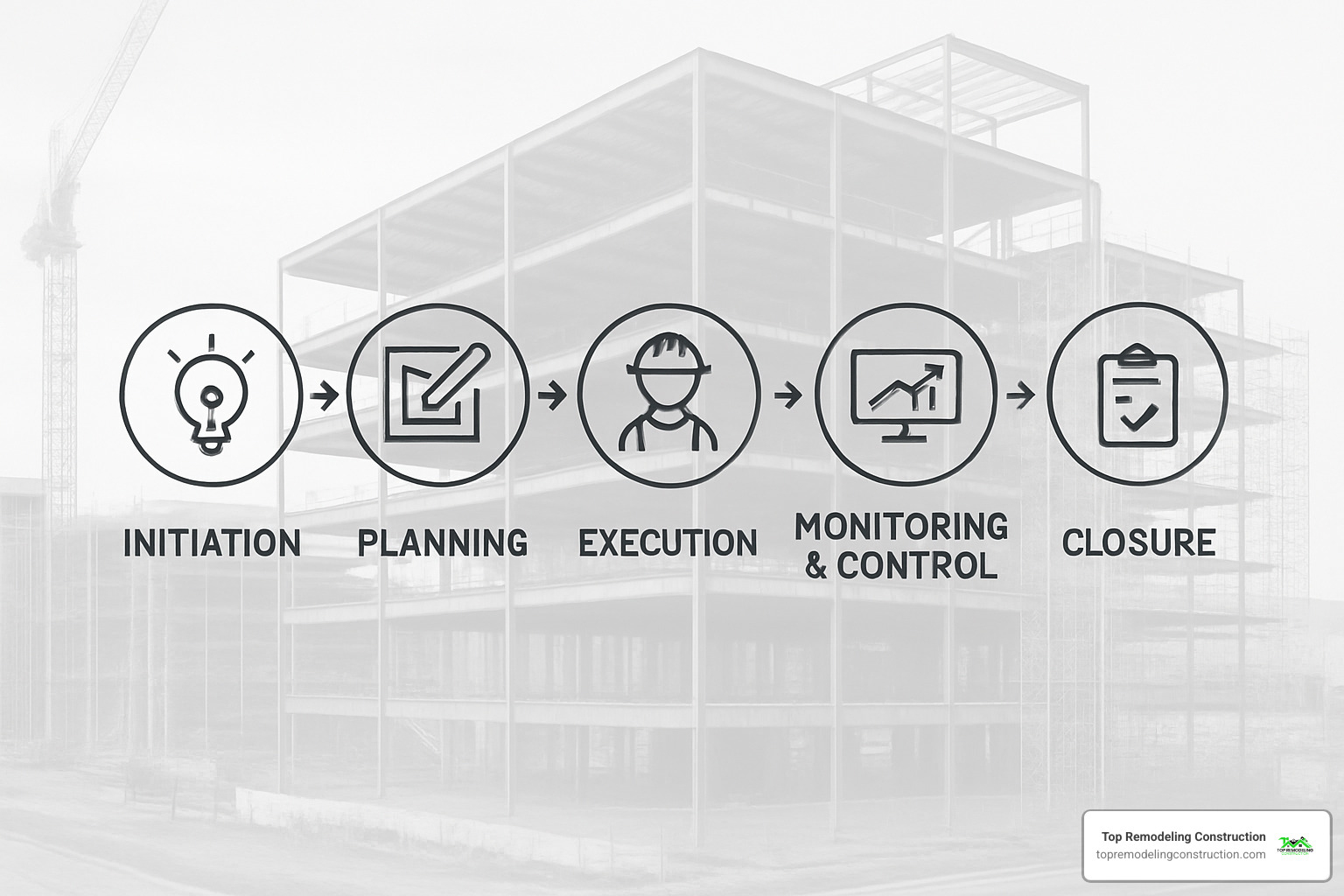
Every construction project follows the same basic rhythm: you start with an idea, plan it out, build it, keep an eye on progress, and wrap things up. But commercial construction management takes this simple framework and expands it into a much more detailed dance.
Think of it like cooking a family dinner versus catering a wedding for 200 people. The basic steps are the same, but the complexity level jumps dramatically. Commercial projects typically break down into eight detailed phases to handle all the moving pieces.
The Construction Management Association of America has identified several delivery models, each with its own personality and approach to handling risk and fees. Pure CM keeps things simple by providing advice only – the owner still contracts directly with everyone else. It’s like having a really smart friend help you coordinate your project while you keep control of the checkbook.
CM as Agent strikes a middle ground, acting as your representative while maintaining that advisory role. CM at Risk is the most popular choice because the construction manager actually guarantees a maximum price, taking on the construction risk so you don’t have to lose sleep over cost overruns.
Then there’s Design-Build, which bundles everything under one contract. It’s streamlined and efficient, though you might give up some control over design decisions in exchange for simplicity.
The 8-Stage Commercial Construction Management Process
Project initiation is where dreams meet reality. This phase involves digging into feasibility studies, checking market conditions, and making sure your vision actually makes sense. Site analysis becomes crucial here – you need to know what’s hiding underground, where utilities run, and whether any environmental surprises might pop up.
Planning and design brings your vision to life on paper. This is where construction managers coordinate with architects and engineers to develop comprehensive plans. Getting permits and clearances happens here too, because nobody wants to start building only to get shut down by the city.
Pre-construction is all about the details. Budgets get refined, schedules become real, and contingencies get built in for those inevitable “we didn’t see that coming” moments. This phase also involves finding and vetting contractors based on their track record and safety performance.
Procurement and bidding manages the competitive process of finding the right teams for your project. Construction managers evaluate proposals, negotiate contracts, and increasingly use building information modeling (BIM) for accurate quantity takeoffs and clash detection.
Construction execution is where the rubber meets the road. Daily coordination, subcontractor scheduling, and safety protocol enforcement all happen here. Regular communication through progress meetings keeps everyone aligned and informed.
Monitoring and control involves constantly checking progress against schedules and budgets. When things go off track – and they will – this is when corrective actions get implemented. Documentation becomes critical during this phase.
Commissioning brings everything together for final inspections and system testing. Punch list items get addressed, and certificates of occupancy get obtained. It’s like the final dress rehearsal before opening night.
Project closeout wraps up all the loose ends. Final documentation gets completed, contracts get closed out, and the keys get handed over. Warranty information and maintenance recommendations ensure the building keeps performing long after construction ends.
Core Responsibilities of a Commercial Construction Manager
Commercial construction management involves wearing many different hats throughout a project’s lifecycle. Cost control sits at the heart of everything – it involves detailed estimating, budget development, and continuous financial monitoring. The numbers don’t lie: 84.9% of projects with professional construction management come in on or under budget, compared to only 81.9% without such oversight.
Schedule management requires sophisticated planning and resource allocation. Construction managers develop comprehensive timelines, coordinate multiple trades to avoid conflicts, and implement recovery strategies when delays inevitably occur. The data shows that 68.8% of professionally managed projects finish on or ahead of schedule versus 65.9% of those without professional management.
Quality control goes far beyond casual inspections. It involves developing comprehensive QA/QC plans, conducting regular material testing, and ensuring compliance verification. As one industry expert put it: “Quality of work has a direct impact on project profitability and reputation, making quality management imperative.”
Safety administration represents a non-negotiable responsibility. Construction managers implement structured safety programs, conduct regular training sessions, and maintain OSHA compliance. Companies track safety performance through Experience Modification Rates (EMR), where lower rates indicate better safety records and reduced insurance costs.
Contract administration involves the business side of construction – negotiating agreements, managing change orders, and resolving disputes when they arise. This function requires understanding construction law, risk allocation, and dispute resolution mechanisms.
Communication serves as the thread that weaves all other responsibilities together. Construction managers facilitate information flow between owners, architects, engineers, and contractors. They conduct regular meetings, prepare progress reports, and ensure everyone stays aligned on project objectives. Without strong communication, even the best-planned projects can fall apart.
Sustainability has become increasingly important as owners seek LEED certification and energy-efficient buildings. Modern construction managers coordinate green building strategies and ensure compliance with environmental standards throughout the construction process.
Skills, Qualifications & Career Advancement
Breaking into commercial construction management might seem overwhelming at first, but the path is clearer than you’d think. The best managers share certain key traits that you can develop over time.
Leadership and communication skills matter more than anything else. You’ll spend your days coordinating everyone from architects to electricians, and each group speaks their own language. The ability to translate between different trades while keeping everyone motivated separates good managers from great ones.
Think about it this way: one day you might need to explain why a design change affects the budget to a frustrated owner, then turn around and help resolve a scheduling conflict between the plumbing and electrical crews. It’s like being a diplomat, translator, and problem-solver all rolled into one.
Technical knowledge forms your foundation. You need to understand construction estimating, building codes, and modern tools like Building Information Modeling (BIM). Don’t worry if this sounds intimidating—most of this comes from hands-on experience rather than textbooks.
The financial rewards make the effort worthwhile. Construction managers earned a median annual wage of $106,980 in May 2024. The top earners bring home more than $176,990 annually, with those in heavy civil engineering commanding even higher salaries at $121,060 median.
Most successful managers start with a bachelor’s degree in construction management, engineering, or business. But there’s good news if you’re looking to change careers: many professionals enter through apprenticeships and internships that provide real-world experience.
For local education options, Gwinnett Tech offers construction management programs at $107 per credit hour plus fees. Their curriculum covers everything from construction graphics and safety to estimating and contract administration. More info about education options can help you explore different pathways into this growing field.
The industry projects 9% growth through 2033—much faster than most other careers. This means about 45,800 new openings each year, driven by ongoing infrastructure investment and commercial development across the country.
Licensing, Certification & Continuing Education Paths
Professional certifications can fast-track your career and boost your credibility with clients. The Certified Construction Manager (CCM) credential stands as the industry’s gold standard, though you’ll need at least 48 months of construction experience to qualify.
If you’re just starting out, the Associate Constructor (AC) certification provides an excellent entry point. More experienced professionals often pursue the Certified Professional Constructor (CPC) designation. Those interested in integrated project delivery should consider Design-Build Institute of America (DBIA) certifications.
OSHA safety training isn’t optional—it’s essential. Beyond basic requirements, specialized certifications in areas like concrete work through the American Concrete Institute (ACI) can set you apart from the competition.
The Construction Manager in Training (CMIT) program offers new graduates a structured path forward. This approach pairs you with experienced mentors while gradually increasing your responsibilities. It’s like having training wheels until you’re ready to manage projects independently.
Don’t think certification ends once you land your dream job. The construction industry evolves constantly with new technologies, materials, and regulations. Successful managers stay current through workshops, seminars, and industry conferences. Think of it as an investment in your future earning potential.
Typical Career Path & Job Outlook
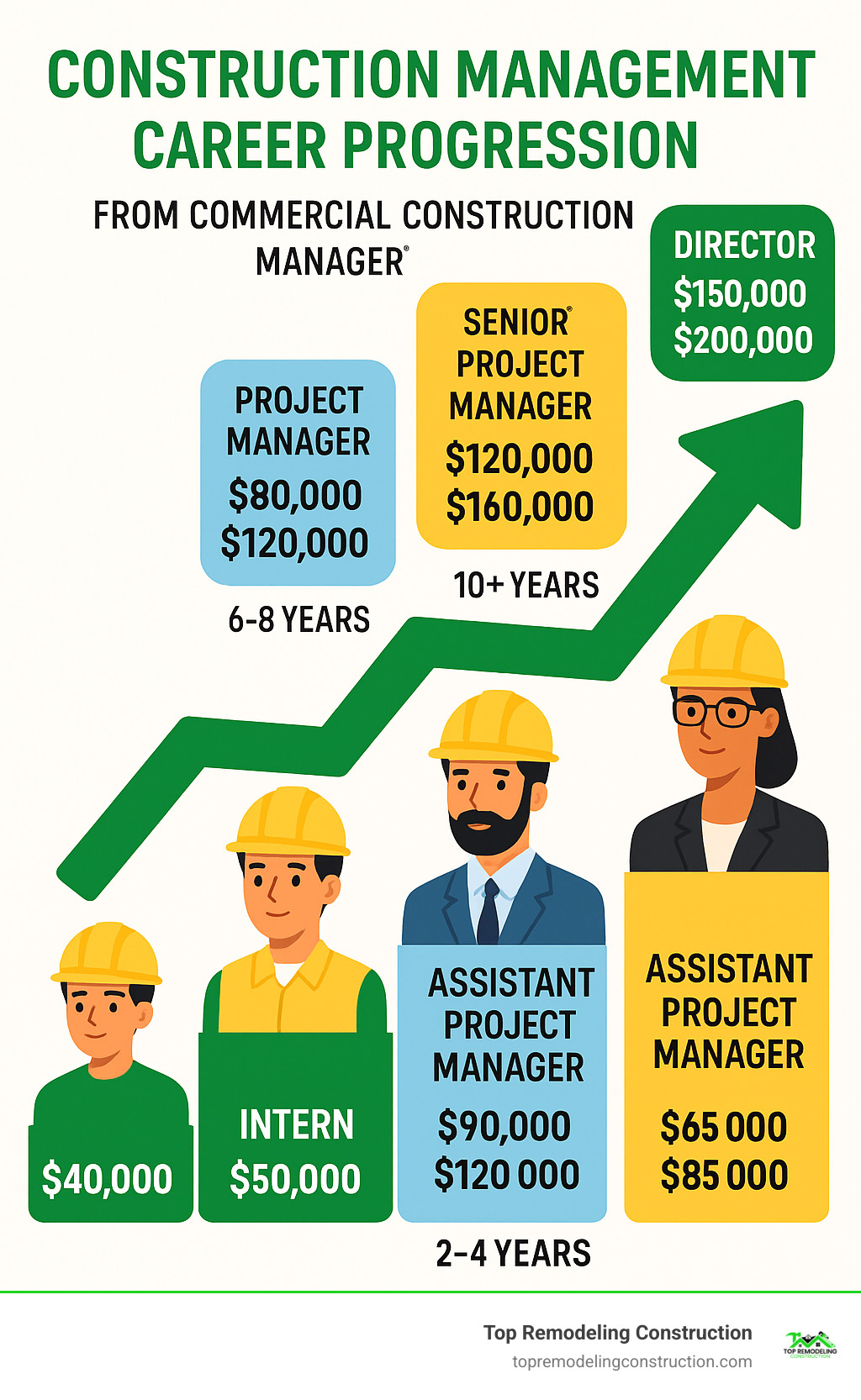
Most construction management careers follow a predictable progression that’s both encouraging and achievable. You’ll typically start as an intern or assistant project manager, learning the ropes while working alongside experienced professionals. This foundation period usually lasts 2-4 years and gives you exposure to every aspect of project management.
The next step involves promotion to project manager, where you’ll take responsibility for smaller projects or specific phases of larger ones. This is where the real learning happens—you’ll develop leadership skills, learn to interact with clients, and gain comprehensive oversight experience.
Senior project managers and construction directors represent the next level up. At this stage, you’re overseeing multiple projects simultaneously and managing teams of junior staff. The work requires strategic thinking, business development skills, and advanced technical expertise.
Here’s where things get interesting: 36% of construction managers eventually become self-employed. This path offers greater earning potential and the freedom to choose your projects, though it requires developing business and risk management skills beyond pure construction knowledge.
The job outlook couldn’t be better. Employment is projected to grow 9% from 2023 to 2033—much faster than most other occupations. The Bureau of Labor Statistics expects about 45,800 openings each year over the next decade, driven by continued infrastructure investment and commercial development.
Geographic location plays a big role in earning potential. Areas with active commercial development and tourism-related construction create strong demand for experienced construction managers. The highest 10% of earners bring home $176,990 or more annually, proving that expertise and experience pay off handsomely in this field.
Technology, Risk Management & Quality Control
The construction industry has come a long way from clipboards and paper blueprints. Today’s commercial construction management relies heavily on cutting-edge technology that makes projects run smoother, safer, and more efficiently.
At the heart of modern construction management sits project management software that acts like a digital command center. These platforms handle everything from assigning tasks and tracking progress to monitoring budgets and storing documents. Think of it as having your entire project in one organized digital workspace that everyone can access.
Building Information Modeling (BIM) has completely transformed how we plan and execute projects. Building information modeling (BIM) creates detailed 3D models that let you walk through a building before it’s even built. This technology catches problems early—like pipes running through beams—saving thousands of dollars in rework costs.
The sky’s literally the limit with drones and robotics now supporting construction sites. Drones can survey large areas quickly, monitor progress from above, and even conduct safety inspections in dangerous locations. Meanwhile, robots help with precise measurements and documentation, reducing risks to human workers.
Mobile technology keeps everyone connected in real-time. Field workers can access the latest plans, report issues instantly, and update progress from their phones or tablets. No more waiting until the end of the day to find problems that could have been solved hours earlier.
Risk management in commercial construction requires a systematic approach to identifying and addressing potential problems before they derail your project. Smart managers create detailed risk registers that catalog everything from weather delays to material shortages, along with specific plans to handle each scenario.
Quality control involves creating comprehensive QA/QC plans that spell out exactly when inspections happen, what tests are required, and what standards must be met. Regular audits catch issues early, preventing small problems from becoming expensive disasters.
Essential Tools for Modern Commercial Construction Management
Today’s construction managers have access to powerful software platforms that integrate multiple functions into seamless workflows. These tools handle scheduling, cost tracking, document management, and communication all in one place, eliminating the confusion of juggling multiple systems.
Professional platforms like Procore lead the industry by offering comprehensive project management capabilities. Smartsheet templates provide flexible options for smaller projects or specific tasks. For detailed comparisons of available options, check out the top 10 construction management tools here to find solutions that match your specific needs.
Scheduling applications have revolutionized timeline management. These tools create detailed project schedules, allocate resources efficiently, and identify critical paths that could impact completion dates. When delays happen, they help you quickly see which tasks need attention to get back on track.
Cost management platforms provide real-time budget monitoring that connects directly to your accounting systems. You can track expenses as they happen, manage change orders efficiently, and generate financial reports that show exactly where your project stands financially.
Document management systems solve the age-old problem of version control. Everyone works from the same current plans and specifications, with secure sharing and complete audit trails. This prevents costly mistakes from outdated information.
Mobile applications extend all this functionality to your field teams. Workers can update progress, document issues with photos, and communicate instantly with the office. This real-time connectivity speeds up decision-making and reduces delays from information gaps.
Mitigating Cost, Schedule & Safety Risks
Successful risk mitigation starts with thorough planning and continues throughout construction. The best managers develop detailed risk matrices that identify potential problems, estimate their likelihood and impact, then create specific strategies to address each risk.
Cost risks include unpredictable material prices, labor shortages, and scope changes that seem to appear from nowhere. Smart contracts include price protection clauses, reliable supplier relationships, and clear change order procedures that protect both owners and contractors.
Schedule risks encompass everything from weather delays to permit holdups and coordination conflicts between trades. Experienced managers build buffer time into schedules, maintain proactive communication with all stakeholders, and develop recovery plans before they’re needed.
Safety risks demand comprehensive programs that include thorough worker training, systematic hazard identification, and robust incident reporting systems. Companies with strong safety records enjoy lower insurance costs and fewer project disruptions. Meeting OSHA compliance standards represents just the starting point—leading companies go well beyond minimum requirements.
Quality risks involve defective materials, poor workmanship, and failure to meet specifications. Prevention requires detailed inspection procedures, rigorous material testing protocols, and crystal-clear acceptance criteria. Catching quality issues early prevents expensive rework and schedule delays.
Insurance and bonding provide essential financial protection against various project risks. Performance bonds guarantee project completion even if contractors fail, while liability insurance protects against accidents and property damage. Proper risk transfer through well-written contracts ensures responsibility gets allocated appropriately among all project participants.
Smart contingency budgets typically range from 5-15% of total project costs, depending on complexity and risk factors. These reserves provide flexibility when unexpected issues arise, keeping projects moving forward instead of grinding to a halt over funding disputes.
Benefits, Challenges & FAQs
When you invest in professional commercial construction management, you’re not just hiring someone to watch over your project—you’re gaining a strategic partner who can transform how your construction unfolds. The benefits extend far beyond what most people expect.
Cost control stands out as the most compelling advantage. Studies reveal that 84.9% of professionally managed projects come in on or under budget, compared to only 81.9% of projects without professional oversight. These savings often exceed the management fees themselves, meaning you actually save money by hiring a professional manager.
Schedule performance improvements prove equally impressive. Research shows that 68.8% of projects with professional construction management finish on time or early, versus just 65.9% without such guidance. For commercial properties, this translates into earlier revenue generation and reduced carrying costs—real money in your pocket.
Perhaps the most undervalued benefit is stress reduction. When you have an experienced construction manager handling daily coordination, problem-solving, and stakeholder communication, you can focus on running your business instead of managing construction headaches. This proves especially valuable if construction isn’t your area of expertise.
Quality improvements result from systematic inspection procedures and proactive issue identification. Professional managers catch problems early, preventing costly rework and ensuring your building performs well for years to come. They implement comprehensive quality control programs that protect your investment.
Retained control represents another significant advantage. Unlike design-build arrangements where you might lose some decision-making authority, construction management keeps you in the driver’s seat while providing professional guidance. You maintain final approval on major decisions while benefiting from expert advice.
The scalability of professional management means whether you’re building a small office or a major facility, the same systematic approach applies. This consistency helps ensure successful outcomes regardless of project size.
However, commercial construction management faces real challenges in today’s environment. Supply chain disruptions have become increasingly common, requiring flexible procurement strategies and backup sourcing options. Materials that used to arrive predictably now face uncertain delivery schedules.
Labor shortages in skilled trades create both scheduling pressures and cost escalation risks. Finding qualified electricians, plumbers, and other specialists takes longer and costs more than in previous years. Smart managers build relationships with reliable subcontractors and plan for these realities.
Permitting delays plague many projects, especially in areas with complex regulatory requirements. What used to take weeks now often takes months. Experienced managers develop relationships with regulatory agencies and understand local requirements to minimize approval timeframes.
Technology adoption presents both opportunities and challenges. While new tools offer significant benefits, they require training investments and change management efforts. The key lies in balancing innovation with proven methods to optimize project outcomes.
The solutions often involve proactive planning, strong relationships, and flexible strategies. Professional construction managers who’ve steerd these challenges know how to adapt and keep projects moving forward despite obstacles.
Frequently Asked Questions about Commercial Construction Management
What certifications are required for commercial construction managers?
The certification landscape varies depending on where you’re building and what type of project you’re undertaking. The Certified Construction Manager (CCM) represents the gold standard, requiring at least 48 months of experience and passing a comprehensive exam. Think of it as the industry’s stamp of approval for professional competence.
For newer professionals, the Associate Constructor (AC) provides an entry point, while the Certified Professional Constructor (CPC) serves those with more experience. The Design-Build Institute of America also offers specialized certifications for integrated project delivery.
State licensing requirements differ significantly across the country. Some states require specific licenses for construction managers working on public projects or projects above certain dollar amounts. OSHA safety training is typically mandatory, with many positions requiring 30-hour or supervisory-level certifications.
The bottom line? While you don’t need a wall full of certificates to be effective, the right certifications demonstrate commitment to professional standards and often open doors to better opportunities.
How does CM fee structure work?
Construction management fees typically range from 2-8% of total project costs, though the exact amount depends on project complexity, size, and services provided. Think of it as an investment that often pays for itself through better cost control and schedule performance.
Pure CM arrangements often use fixed fees or cost-plus structures, giving you predictable costs upfront. CM at Risk contracts include guaranteed maximum prices with shared savings provisions—if the project comes in under budget, you might share the savings with your construction manager.
Fee structures may include reimbursable expenses for items like travel, testing, and communications. Some contracts incorporate performance incentives tied to schedule, budget, or quality achievements. The key is having transparent fee discussions early in the selection process to establish clear expectations and avoid surprises.
Which project types need a CM?
Projects exceeding $1 million typically benefit from professional construction management, though smaller complex projects may also warrant professional oversight. If you’re building something with multiple stories, specialized requirements like healthcare or educational facilities, or facing tight schedules, professional management becomes even more valuable.
Public projects often require construction management services due to regulatory requirements and accountability standards. Private owners frequently engage construction managers for projects outside their expertise or when they lack internal construction capabilities.
Renovation projects involving occupied buildings almost always benefit from professional management. The coordination complexities and need to minimize disruption make professional oversight essential. Whether you’re expanding your office while keeping it operational or renovating a retail space between tenants, the investment in professional management typically pays for itself through improved outcomes and reduced stress.
The simple truth? If your project matters to your business success, professional construction management is worth considering. The peace of mind alone often justifies the investment.
Conclusion
Commercial construction management makes the difference between projects that succeed brilliantly and those that become expensive headaches. The numbers don’t lie—professionally managed projects consistently deliver better results, with 84.9% coming in on or under budget and 68.8% finishing on or ahead of schedule.
When you’re investing in a commercial project, you’re betting on your business’s future. That’s exactly why we started Top Remodeling Construction as a family-owned business focused on treating every project like it’s our own. We know that behind every blueprint is someone’s dream, whether it’s a new restaurant, an expanded office, or a complete facility renovation.
Our approach combines old-school values with modern expertise. We believe in answering your calls, showing up when we say we will, and keeping you informed every step of the way. No construction jargon, no surprises, just honest communication about where your project stands and what comes next.
Quality and competitive pricing aren’t mutually exclusive—they’re both non-negotiable in our book. We’ve built our reputation by proving that exceptional customer satisfaction doesn’t have to break the bank. Every detail matters, from the initial site visit through final walkthrough.
The Las Vegas market keeps us on our toes with its unique challenges and opportunities. Desert conditions, rapid growth, and diverse project types mean we’ve seen it all. This local expertise, combined with industry-leading practices, helps us steer everything from permit complexities to material sourcing.
Whether you’re planning a retail space that needs to open by Black Friday, an office expansion that can’t disrupt daily operations, or a restaurant renovation with a tight timeline, we understand the stakes. Commercial construction management isn’t just about coordinating trades—it’s about protecting your investment and your peace of mind.
From feasibility studies that help you make smart decisions to final punch lists that ensure everything works perfectly, we’re your advocates throughout the entire process. We handle the coordination headaches so you can focus on running your business.
Ready to see how the right construction management team can transform your project experience? More info about our full-service approach shows exactly how we turn construction stress into construction success. Let’s talk about your vision and how we can make it reality—without the usual drama that comes with commercial projects.