Beyond Ballpark Figures: The Critical Role of Construction Cost Estimation
A commercial construction cost estimator is a specialized professional or software tool that calculates the total expenses of building commercial structures by analyzing plans, materials, labor, equipment, and site conditions to produce accurate budget forecasts.
“Accurate construction estimates ensure projects are completed within budget and on time, leading to increased profitability and client satisfaction.” – RSMeans Data
What a Commercial Construction Cost Estimator Does:
| Function | Description |
|---|---|
| Initial Assessment | Evaluates project scope, location, and complexity |
| Quantity Takeoffs | Measures and calculates required materials |
| Labor Calculation | Determines workforce needs and associated costs |
| Equipment Estimation | Projects machinery and tool expenses |
| Overhead & Profit | Factors in indirect costs and contractor margins |
| Risk Analysis | Adds contingencies for unforeseen circumstances |
Before starting on any commercial construction project, understanding the true costs involved is paramount. Whether you’re building a retail space, office complex, or warehouse, accurate cost estimation stands as the foundation of project success.
The median construction cost for a single-story commercial office building in the US ranges from $289 to $437 per square foot, depending on location and other factors. With such significant investments at stake, guesswork simply isn’t an option.
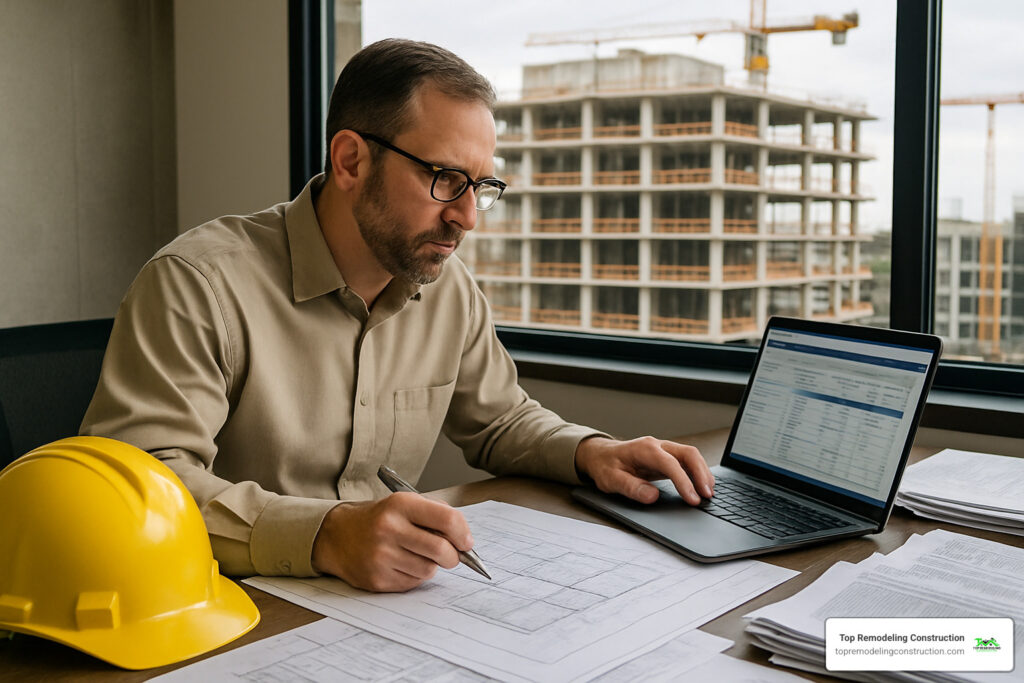
Today’s commercial construction relies on specialized estimators who combine industry knowledge with powerful software tools to forecast expenses with unprecedented precision. These professionals analyze everything from material quantities and labor rates to equipment needs and permit costs—often reducing estimation time from days to minutes while improving accuracy.
For project owners, investors, and contractors alike, the difference between profit and loss often comes down to the quality of the initial estimate.

Simple commercial construction cost estimator word guide:
– commercial construction business
– commercial construction financing
Understanding the Science of Cost Estimation
Ever wonder why some construction projects stay on budget while others spiral out of control? The answer lies in the science of cost estimation. At Top Remodeling Construction, we’ve turned this science into an art form through years of successful projects across Las Vegas.
Good estimation starts with thorough scope definition. Every doorknob, light fixture, and square foot of flooring needs to be accounted for. Then our commercial construction cost estimator professionals apply cost indices – those standardized values that tell us what materials and labor actually cost in Las Vegas right now, not last year or in another state.
Regional multipliers are another piece of the puzzle. While national construction cost averages provide a starting point, Las Vegas has its own unique factors. Our team has developed precise multipliers based on local material availability, labor rates, and regulatory requirements that affect our area specifically.
Contingency planning is where experience really shines. Most professional estimates include a 10-15% contingency because, as one contractor we work with puts it: “There’s no such thing as a perfect estimate—only ones that properly account for uncertainty.”
When breaking down costs, we typically see labor accounting for 20-40% of total construction costs, while materials make up 17-25%. And don’t forget those permitting fees! Though they represent just 0.5-2% of total project costs, overlooking them is a rookie mistake we never make.
Inflation trends also demand attention, especially for longer projects. Construction costs currently inflate at about 3-5% annually, though supply chain hiccups can send this number higher without warning.
Why Accurate Estimates Matter
Have you ever gone over budget on a home project and felt that sinking feeling? Now imagine that on a commercial scale. Here’s why precision is non-negotiable:
Profitability isn’t just about making money—it’s about staying in business. At Top Remodeling Construction, we’ve seen how a mere 5% estimation error can translate to tens of thousands of dollars in unexpected costs. Underestimate, and profits vanish; overestimate, and clients look elsewhere.
Schedule Certainty depends on proper resource allocation. When budgets get squeezed due to poor estimates, the temptation to cut corners or substitute cheaper materials leads to delays and quality issues nobody wants.
Lender Confidence is critical since most commercial projects require substantial financing. Banks scrutinize our estimates carefully, and inaccuracies can jeopardize funding or force costly refinancing mid-project.
“The estimating software allowed us to verify that they could hit their ROI given the site constraints.” – Zach Freshner, Program Director
Stakeholder Trust might be the most valuable currency in construction. Our reputation at Top Remodeling Construction for delivering projects within budget has become our calling card in Las Vegas. When clients can trust our numbers, everything else runs smoother.
Hard Costs vs Soft Costs – Know the Difference
Think of hard costs as everything you can touch and soft costs as everything you can’t. Both are essential to your budget, but they work differently:
| Hard Costs | Soft Costs |
|---|---|
| Site preparation | Architectural & engineering fees |
| Foundation work | Permits & inspection fees |
| Structural components | Legal & accounting services |
| MEP systems | Construction loan interest |
| Interior finishes | Insurance premiums |
| Exterior elements | Marketing expenses |
| Labor for physical construction | Project management fees |
| Construction equipment | Contingency reserves |
Hard costs make up about 70-80% of your total budget—they’re the concrete, steel, and sweat that physically create your building. Foundation work typically represents about 11.3% of total construction costs, while interior finishes can reach nearly 29.1%.
Soft costs might be less visible, but they’re just as important. These indirect expenses typically account for 20-30% of your total budget. At Top Remodeling Construction, we’ve learned that thoroughly accounting for soft costs from day one prevents those uncomfortable “by the way” conversations later.
As one of our veteran estimators likes to say, “Hard costs get all the attention because they’re tangible, but it’s often the soft costs that derail budgets when not properly estimated.”
Understanding both types of costs gives you the complete picture—and complete pictures lead to successful projects.
The Role of a Commercial Construction Cost Estimator
A commercial construction cost estimator is much more than a number-cruncher – they’re the financial navigators who guide construction projects safely from dream to reality. At Top Remodeling Construction, we see our estimators as the unsung heroes who transform architectural visions into practical budgets that work in the real world of Las Vegas construction.

Think of estimators as financial translators – they speak both the language of design and the language of dollars. They combine technical know-how with market wisdom to create the roadmap that keeps projects financially on track.
Our estimators at Top Remodeling Construction draw on several powerful approaches to build accurate forecasts:
When we need quick ballpark figures, we turn to parametric methods. This approach uses mathematical relationships to generate estimates based on key project characteristics. For instance, knowing that a typical office building runs between $330-$870 per square foot gives us a solid starting point when a client calls with a new office project idea.
For precision work, nothing beats bottom-up take-offs. This is where our estimators roll up their sleeves and count everything – from cubic yards of concrete to every electrical outlet. It’s meticulous work, but the accuracy it provides is worth every minute spent.
We also rely heavily on historical benchmarking, drawing on our extensive experience with similar projects throughout Las Vegas. There’s wisdom in what’s already been built, and we tap into that knowledge while adjusting for today’s unique conditions and current material prices.
Our quantity surveying approach brings system and structure to the estimation process. Using specialized software, we can quickly measure and calculate material needs with remarkable precision – turning what used to take days into a matter of hours.
As one of our senior estimators likes to say: “A good commercial construction cost estimator doesn’t just count things – they see the financial story hidden in the blueprints, and help clients understand what that story means for their budget.”
Typical Steps in the Estimating Process
At Top Remodeling Construction, we’ve refined our estimation process through years of commercial projects across Las Vegas. Our approach follows a clear path that grows more detailed as projects develop:
We begin with thorough document review, carefully examining every available piece of project information. Our estimators pore over architectural drawings, specifications, soil reports, and site surveys – leaving no page unturned. This foundation-setting step helps us understand not just what we’re building, but what challenges might be lurking beneath the surface.
For early project stages, we develop preliminary square foot models that give clients a reliable starting point for decision-making. From industry databases like RSMeans, we establish baseline costs that help answer the critical early question: “Is this project financially feasible?”
As designs firm up, we transition to detailed line items – the nuts-and-bolts of estimation. This is where we calculate precise quantities for everything from foundation concrete to roofing materials, assigning current market prices to each element.
The bid leveling phase is where our experience really shines. When subcontractor quotes arrive, we carefully compare them – making sure each covers identical scope and identifying any hidden exclusions that could cause budget surprises later.
Throughout construction, we provide change-order updates that keep the budget current as the project evolves. This transparency helps prevent the sticker shock that can come with untracked changes.
“We kick out budget numbers for clients in minutes rather than taking hours of time to get one put together.” – Nathan Grant, Project Manager
This thoughtful process ensures our clients always have clear financial visibility as their projects move from concept to completion. More info about projects
How Often Should Estimates Be Updated?
Construction estimates aren’t carved in stone – they’re living documents that need regular refreshing to stay accurate. At Top Remodeling Construction, we’ve learned that timing these updates strategically keeps projects financially healthy.
Design milestones provide natural checkpoints for estimate updates. Each major design phase brings greater detail and clarity, allowing us to tighten our accuracy ranges:
– During early conceptual design, we expect accuracy within 15-20%
– By design development, we narrow to 10-15%
– With construction documents in hand, we reach 5-10%
– Final bid documents allow us to achieve 3-5% accuracy
Market shifts can’t be ignored when it comes to estimate validity. When lumber prices doubled seemingly overnight in 2021, we immediately revised our active estimates rather than waiting for the next scheduled update. Our clients appreciate this proactive approach to market reality.
Supply chain disruptions have become a fact of life in construction. When delivery times stretch or materials become scarce, we adjust our estimates to reflect these changing conditions and their potential cost impacts.
The construction industry’s standard pricing data, like RSMeans Data, updates quarterly with fresh pricing information. We incorporate these updates into our ongoing estimates to ensure we’re working with the most current figures available.
For most active projects, we review estimates monthly during design phases and immediately after any significant scope changes. This vigilance ensures our Las Vegas clients always have the most current information for making sound financial decisions about their commercial construction projects.
Key Cost Drivers Per Square Foot
Understanding what drives costs in commercial construction isn’t just about numbers—it’s about seeing the bigger picture of your investment. These factors can dramatically change your bottom line, sometimes creating a 50% cost difference between seemingly similar projects.
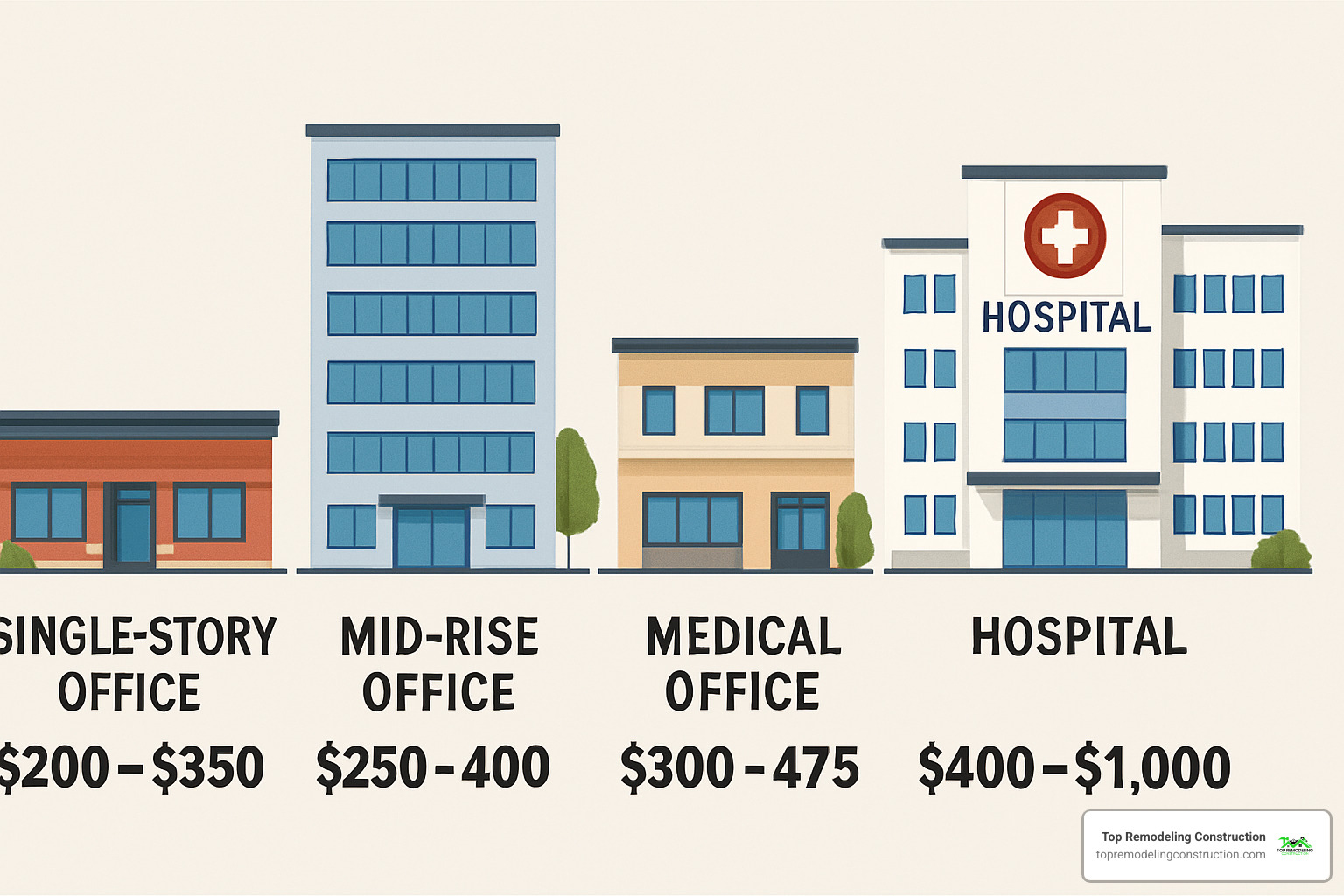
When we sit down with clients at Top Remodeling Construction, we often explain that building type is your first major cost determinant. The numbers tell the story—a basic warehouse might run you just $14-$22 per square foot, while a hospital could easily exceed $1,000. Single-story offices typically fall between $289-$437, while hotels can range from $478 up to $1,327 depending on amenities and star rating.
Finish level is where many projects find wiggle room in the budget. Economy finishes keep costs down with basic materials and standard systems. As you move up to mid-grade, you’re investing in better durability and modest aesthetic improvements. High-end finishes bring premium materials and improved systems, while luxury level means custom everything and state-of-the-art technology throughout.
The bones of your building—its structural system—creates another significant cost variable. Wood frame construction generally offers the lowest entry point, while steel frame costs more but often enables faster construction. Concrete systems, especially with complex forms, push costs higher, and hybrid systems vary based on their specific combinations.
Don’t underestimate the impact of MEP intensity—the mechanical, electrical, and plumbing systems typically account for 25-35% of your total construction costs. Buildings with specialized needs like data centers, laboratories, or healthcare facilities see this percentage climb even higher.
The land beneath your feet matters too. Challenging site conditions can quickly inflate your budget through extensive excavation work, poor soil requiring improved foundations, limited site access restricting equipment, or environmental remediation requirements. We’ve seen seemingly straightforward projects in Las Vegas become complex due to unexpected site issues.
Going green has its price tag too. Sustainability features generally add upfront costs while potentially reducing long-term operational expenses. Energy-efficient systems typically add a 2-5% premium, while LEED certification adds 1-6% depending on the level you’re targeting. Net-zero capabilities represent the highest investment at a 5-15% premium.
As experienced commercial construction cost estimators in Las Vegas, our team at Top Remodeling Construction carefully analyzes each of these drivers for your specific project. We believe in giving you a complete picture—not just a number—so you can make informed decisions about your commercial construction investment.
Location & Market Factors
Where you build might matter as much as what you build. Industry experts have documented up to 70% cost variations for identical buildings constructed in different locations.
Las Vegas has its own unique construction cost fingerprint. As a desert city driven by tourism and entertainment, our local factors create specific challenges and opportunities that impact your bottom line. The city cost index for Las Vegas reflects our distinctive economic patterns, local building codes, and workforce characteristics.
The labor landscape here presents an interesting mix. Las Vegas offers both union and open-shop options, giving projects flexibility. While union labor typically comes with higher hourly rates, the specialized training and potential productivity advantages sometimes offset these costs for certain project types.
Our desert climate shapes construction in ways outsiders might not anticipate. The intense heat demands robust HVAC systems, while high UV exposure requires more durable exterior finishes. The silver lining? Our minimal rainfall allows for certain construction efficiencies, though the seasonal temperature extremes definitely affect construction scheduling.
Local zoning requirements create another layer of cost considerations. Parking mandates, height restrictions, setback requirements, design review processes, and impact fees all vary significantly based on your specific location within the Las Vegas area. These regulations aren’t just red tape—they translate directly to dollars in your budget.
At Top Remodeling Construction, we’ve spent years building our understanding of these local factors. This deep regional knowledge helps us create estimates that capture Las Vegas-specific conditions that out-of-town contractors might miss. We’re proud to offer this local expertise as part of our commitment to budget accuracy. Latest research on cost per unit
Building Type Breakdowns
Every commercial building category comes with its own cost profile and unique considerations. Let’s walk through what drives costs in each major building type:
When it comes to office buildings, the class system tells much of the story. Class A premium offices ($350-$870 per square foot) feature impressive lobbies, sophisticated elevator systems, and smart building technology. Class B mid-tier spaces ($289-$350) offer good quality with fewer bells and whistles, while Class C basic offices ($150-$289) provide functional space without the frills.
Warehouse construction offers some of the most cost-effective commercial space, with basic storage facilities running just $14-$22 per square foot. Add office space and distribution capabilities, and costs rise to $30-$80. Specialized needs like cold storage push budgets to $80-$120 per square foot. The big cost factors? Clear height requirements, floor load capacity, dock equipment, and HVAC specifications.
Healthcare facilities represent some of the most complex and costly commercial construction. Medical office buildings start at $451-$1,018 per square foot, outpatient surgery centers run $650-$1,200, and full hospitals easily exceed $800-$1,500. The premium comes from specialized systems, infection control measures, medical equipment integration, and extensive regulatory compliance requirements.
The retail world spans a broad spectrum, from basic shell construction at $56-$100 per square foot to high-end tenant improvements reaching $200+ per square foot. Restaurants demand even more investment at $160-$350 due to kitchen requirements. Your storefront design, fixture allowances, and brand-specific elements will significantly influence where you fall in these ranges.
Hospitality projects reflect their star ratings in their construction costs. Economy hotels can be built for $150-$300 per square foot, mid-scale properties range from $300-$500, and luxury experiences demand $500-$1,300+. Your FF&E package (furniture, fixtures, and equipment), amenity spaces, and kitchen facilities drive much of this variation.
Parking structures might seem straightforward but have their own cost considerations. Basic above-ground structures typically run $90-$120 per square foot, while underground parking jumps to $150-$200+ due to excavation and structural requirements. Integrating parking with other uses adds another 15-30% to these figures.
Data centers represent some of the most technically demanding commercial spaces. Even basic Tier I/II facilities cost $500-$800 per square foot, while mission-critical Tier III/IV centers reach $800-$1,500+ per square foot. The premium pays for power density, sophisticated cooling systems, redundancy measures, and improved security features.
As a commercial construction cost estimator team at Top Remodeling Construction, we leverage our understanding of these building-specific cost profiles to develop preliminary estimates that help our clients make informed decisions about project feasibility right from the start.
Digital Tools That Boost Accuracy & Speed
Gone are the days of estimating projects with just a pencil, paper, and calculator. Today’s commercial construction cost estimator professionals have acceptd sophisticated digital tools that dramatically improve both their accuracy and efficiency.
When I first started in this industry, estimating a medium-sized commercial project could take days. Now, with the right digital tools, we can turn around preliminary numbers in hours or even minutes – and with greater precision than ever before.
Cost databases like RSMeans Data Online have been game-changers. These digital treasure troves contain current pricing for over 85,000 construction items across 970+ North American locations. They’re updated quarterly, ensuring we’re always working with fresh market rates. No more guessing if that concrete price from six months ago is still valid!
Our team at Top Remodeling Construction loves using square-foot models built into modern estimating platforms. These pre-built templates for dozens of building types allow us to quickly generate conceptual budgets by simply entering basic parameters like size, location, and quality level. It’s like having an experienced estimator’s brain at your fingertips.
Cloud estimating has revolutionized how we collaborate. Remember when we had to email spreadsheets back and forth, never quite sure who had the latest version? Those headaches are history. Web-based platforms now enable real-time collaboration among team members with version control and access from anywhere – perfect for coordinating across our Las Vegas projects.
For precise measurements, digital takeoff tools like PlanSwift have been invaluable. They allow us to measure directly from digital plans, automatically calculating areas, volumes, and quantities. The precision far exceeds manual methods, and the time savings are substantial. What used to take hours can now be completed in minutes.
We’re also keeping our eye on emerging AI-powered calculators that analyze historical project data to predict costs, flag potential estimation errors, and suggest value engineering opportunities. While the technology is still maturing, the potential to learn from past projects is enormous.
Clients particularly appreciate our real-time dashboards that visualize cost breakdowns, compare alternatives, and track changes throughout the design process. These interactive tools transform complex spreadsheets into clear visuals that help everyone understand where the money is going.
The impact of these technologies is substantial. Research shows digital estimating tools can reduce calculation time from days to minutes while improving accuracy by eliminating human calculation errors. That said, at Top Remodeling Construction, we believe the most powerful approach combines these digital tools with human expertise that understands the unique construction environment of Las Vegas.
Comparing Popular Estimating Platforms
With so many estimating solutions on the market, choosing the right platform can feel overwhelming. Having tested many of these systems ourselves, we’ve identified the key factors worth considering.
Feature sets vary widely across platforms. The most comprehensive systems offer robust cost databases, square foot modeling capabilities, assembly-based estimating tools, historical cost tracking, change order management, and multi-user collaboration. Some specialized platforms excel in specific areas but lack breadth of coverage.
Ease of use might be the most underrated factor in platform selection. Even the most powerful estimating software fails if your team finds it frustrating or confusing. Look for intuitive interfaces, reasonable learning curves, mobile accessibility, readily available templates, customizable reports, and strong support resources. We’ve found that platforms with video tutorials and responsive customer service significantly reduce implementation headaches.
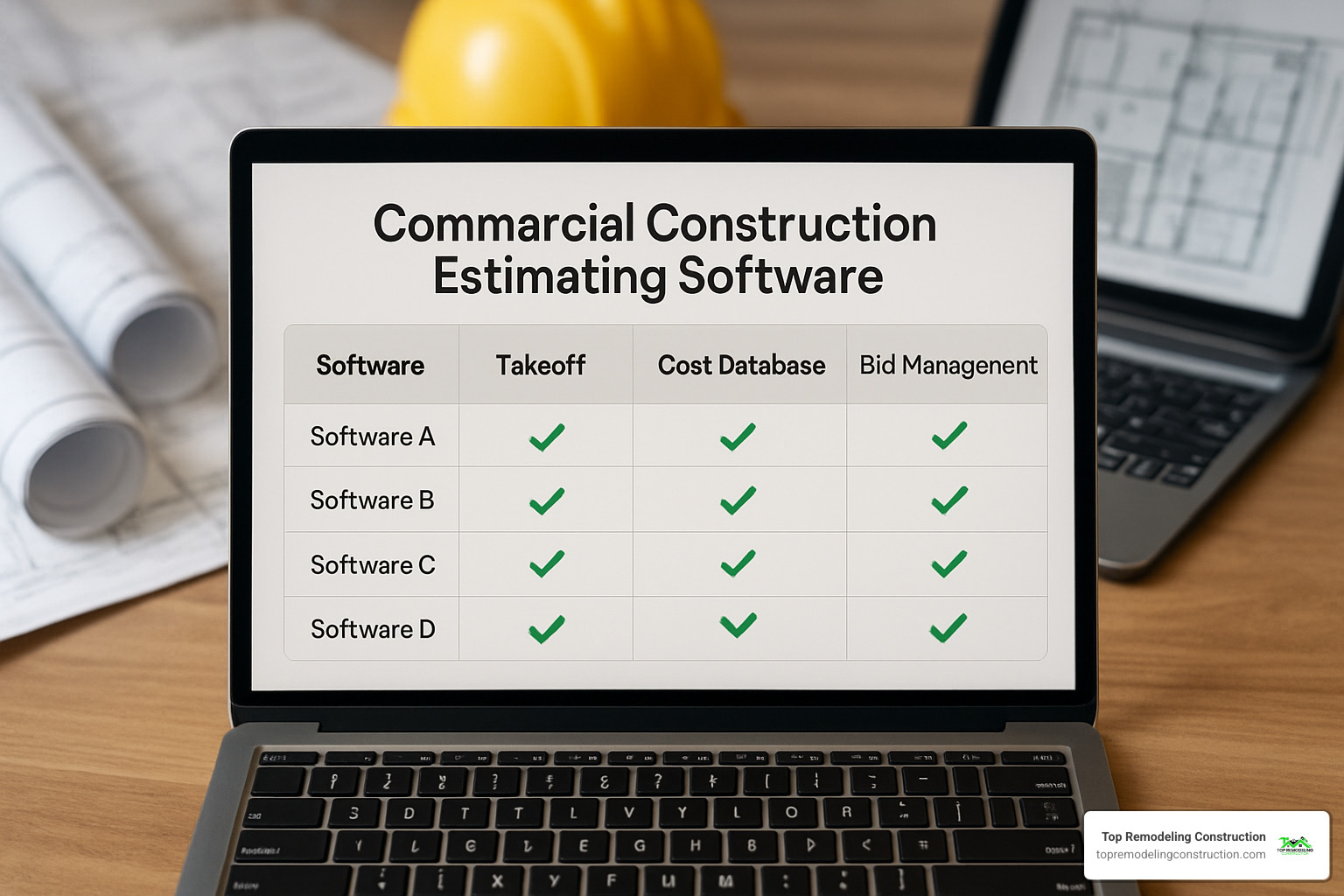
Collaboration capabilities have become increasingly important as construction teams become more distributed. The best platforms offer real-time multi-user editing, comment and markup tools, version control, permission management, client presentation features, and subcontractor bid management. At Top Remodeling Construction, we’ve found that strong collaboration features pay for themselves by reducing miscommunication and rework.
API and integration options determine how well your estimating software plays with other systems. Look for connections to project management software, accounting systems, BIM/CAD compatibility, document management links, scheduling tool coordination, and custom data exchange options. The goal is a smooth flow of information across your entire technology ecosystem.
Our experience shows that the most effective estimating platforms provide automatic quarterly updates to cost data, location-specific cost adjustments for Las Vegas and beyond, the ability to save and reuse custom assemblies, robust reporting capabilities, and cloud-based access from multiple devices.
When evaluating options as a commercial construction cost estimator, consider your organization’s specific needs and typical project types. A platform perfect for high-rise office buildings might be overkill for retail tenant improvements. Scientific research on software productivity confirms that matching software capabilities to actual workflow needs yields the best results.
Leveraging a Commercial Construction Cost Estimator App
Mobile applications have transformed how we approach cost estimation in the field. A quality commercial construction cost estimator app brings powerful capabilities directly to our smartphones and tablets, enabling on-site decisions with real-time cost data.
I remember walking a potential renovation site with a client who suddenly asked, “What if we added another window here?” Before mobile apps, I’d have had to say, “Let me get back to the office and run those numbers.” Now, I can provide an educated estimate on the spot, making the client experience much more interactive and satisfying.
Mobile inputs allow us to capture measurements, photos, and notes directly at the jobsite. This eliminates the need to scribble observations on paper and later transfer them to office systems – a process prone to errors and omissions. When we spot an unexpected condition that might affect costs, we document it immediately.
Location-based pricing is particularly valuable in a diverse market like Las Vegas, where costs can vary even between different parts of the city. Good mobile apps automatically adjust cost data based on GPS location, ensuring estimates reflect local conditions without manual intervention.
Exportable reports have saved us countless hours. We can generate professional estimate documents that are immediately shared with clients, subcontractors, or team members via email or cloud storage. This capability often turns what would have been a follow-up meeting into an on-the-spot decision.
Offline functionality is crucial for construction sites with spotty connectivity. The best apps continue working without internet access, then automatically synchronize when connection is restored. This ensures we never lose data, even when working in remote areas or basement levels with poor signal.
Integration with desktop systems creates a seamless workflow between field and office. When our estimators return from site visits, their mobile data transfers directly to our main estimating platform, maintaining a single source of truth for project estimates.
At Top Remodeling Construction, mobile estimating technology has dramatically improved our responsiveness to client needs across the Las Vegas area. We provide preliminary budget numbers during initial site visits and quickly update estimates based on field conditions or client requests.
For clients considering a commercial construction project, these mobile tools facilitate faster decision-making and more transparent communication throughout the estimation process. If you’re ready to experience this responsive approach to project planning, we’d love to provide a Free Quote for your next commercial venture.
Best Practices for Cost Control & Risk Management
Creating an accurate estimate is just the first step in a successful commercial project—the real challenge lies in maintaining that budget throughout construction. At Top Remodeling Construction, we’ve developed proven strategies to keep our Las Vegas commercial projects financially on track.
Value engineering has become one of our most powerful tools. This isn’t about cutting corners or sacrificing quality—it’s a thoughtful process where we analyze each element to find the sweet spot between function, quality, and cost. For example, we might suggest alternative mechanical systems that deliver identical performance at lower cost, or reconfigure spaces to reduce unnecessary square footage without compromising functionality.
Early supplier engagement makes a tremendous difference in budget accuracy. By bringing key material suppliers and specialty contractors into the conversation during estimation, we get more realistic pricing and can identify potential supply issues before they become expensive problems. As one of our project managers likes to say, “An early conversation costs nothing—a late findy costs plenty.”
Contingency planning requires a nuanced approach based on project complexity. We typically recommend 10-15% contingency for new construction projects, but renovation work usually demands 15-20% due to the unknowns that often hide behind existing walls. Historic buildings or projects with significant site unknowns may require even higher contingencies.
“The most successful projects aren’t necessarily those with the lowest initial estimate, but those with the most comprehensive risk management strategy.”
Bid comparison is an art form in itself. Our team carefully analyzes subcontractor proposals, looking beyond the bottom-line number to ensure every scope item is covered without duplication. This detailed approach prevents the common problem of apparent “savings” that later require expensive change orders.
We’re also transparent about overhead and profit tracking, separating direct costs from these necessary business expenses. This clarity helps everyone understand the true cost drivers and identifies opportunities for greater efficiency.
Industry statistics show about 85% of commercial construction projects experience some degree of budget overrun. At Top Remodeling Construction, we’ve beaten those odds by implementing these practices consistently across our Las Vegas projects.
Incorporating Risk and Value Engineering Into Estimates
The most valuable estimates do more than just add up known costs—they anticipate what might go wrong and identify opportunities to do things better. Our approach combines both art and science to deliver this deeper insight.
We develop multiple scenario analyses for our clients, showing how different risk profiles and design choices might affect the bottom line. Rather than presenting a single number that creates a false sense of certainty, we show the range of possibilities and their likelihood.
For complex projects, we sometimes employ Monte Carlo ranges—a sophisticated statistical technique that runs thousands of simulations to establish confidence levels for different budget outcomes. While it sounds complicated, the result is beautifully simple: a clear picture of how likely different budget scenarios really are.
Material substitution opportunities are highlighted throughout our estimates. We might note that changing from one flooring system to another could save $3 per square foot without compromising appearance or durability. These options empower our clients to make informed decisions about where their budget is best spent.
We also believe strongly in lifecycle costing. A slightly higher investment upfront often yields significant savings over time. Just last year, we helped a Las Vegas retail client select a higher-efficiency HVAC system that cost 12% more initially but reduced energy costs by nearly 8% annually—paying for itself within five years while providing superior comfort.
This thoughtful approach to estimation helps our clients balance immediate budget constraints with long-term value. After all, a building that costs less to construct but drains resources throughout its lifespan isn’t truly economical. What We Do
Validating Contractor Bids
When multiple bids come in for your commercial project, knowing how to evaluate them fairly becomes crucial. The lowest number isn’t always the best value, and the highest doesn’t guarantee superior quality. Here’s how we help clients make sense of competing proposals:
First, we carefully check for scope alignment across all bids. Does each contractor understand exactly what’s required? We look for coverage of all building components, site work, temporary facilities, and testing requirements. It’s surprisingly common to find one bid seems attractive until you notice it’s missing crucial elements that will become expensive add-ons later.
Allowance checks are another critical step. Allowances are essentially placeholders for items not fully defined at bid time—like owner-selected finishes or specialized equipment. We make sure all bidders have included appropriate allowances in comparable amounts. A bid with unrealistically low allowances may look good initially but lead to budget surprises.
We also conduct thorough unit-price audits, analyzing the costs for key materials and labor to spot any outliers. Sometimes an unusually low unit price signals a misunderstanding of requirements or a contractor planning to use lower-grade materials. Conversely, inflated unit prices might indicate padding or risk-shifting.
With today’s volatile material market, reviewing escalation clauses has become essential. We examine how each bidder addresses potential price increases during the project timeline. Clear, fair escalation provisions protect both owners and contractors from unmanageable risk.
This systematic approach helps our Las Vegas clients look beyond the bottom line to select contractors based on the most accurate and comprehensive bid that truly represents the project’s requirements. The commercial construction cost estimator who takes time for this detailed validation often saves clients far more than their fee by preventing costly misunderstandings and change orders.
Frequently Asked Questions about Commercial Construction Cost Estimates
How do I distinguish hard and soft costs in my budget?
One of the most common questions we hear from clients at Top Remodeling Construction involves understanding the difference between hard and soft costs. Think of hard costs as everything you can physically touch in your finished building – they’re the tangible elements that make up the structure itself.
Hard costs typically include your site work and foundations (which usually account for about 11.3% of your total project costs), all structural systems whether they’re steel, concrete, or wood framing, plus your exterior walls, windows, and roofing. They also cover interior construction like partitions and doors, as well as all your mechanical, electrical, and plumbing systems.
Soft costs, on the other hand, are equally important but less visible. These are the behind-the-scenes expenses that make your project possible. Your architectural and engineering fees usually fall between 8-15% of construction costs, while permits and impact fees typically range from 0.5-2%. Other soft costs include financing expenses, interest during construction, legal services, accounting, insurance premiums, and various testing and inspection services.
We always clearly separate these categories in our estimates to give you complete transparency. As one developer who works with us mentioned, “Soft costs often catch first-time commercial builders by surprise, sometimes adding 25-30% beyond the hard construction budget.”
What’s the best way to compare contractor bids fairly?
Comparing bids from different contractors can feel like comparing apples to oranges unless you have a systematic approach. Based on our years of experience in Las Vegas commercial construction, we recommend a thoughtful process to ensure you’re evaluating equivalent proposals.
Start by creating a standardized bid form that all contractors must use – this ensures everyone presents information in the same format. Develop a detailed scope of work document that clearly defines what should (and shouldn’t) be included in the bids. Holding a pre-bid meeting with all potential bidders can also work wonders for answering questions and clarifying expectations up front.
Rather than accepting lump-sum totals, request line-item breakdowns that allow for detailed comparisons. Check for exclusions and qualifications carefully – these might indicate scope gaps or potential change orders down the road. Verify allowance amounts are consistent across all bids, especially for items not fully specified yet.
Don’t forget to review proposed project schedules to ensure timeline expectations align with your needs, and evaluate experience with similar projects to assess each contractor’s relevant expertise. We always recommend checking references specifically about budget performance on previous projects.
Finally, consider value beyond the bottom line. The lowest bid rarely represents the best value when all factors are considered – communication style, problem-solving approach, and quality control systems often make a bigger difference to project success than saving a few dollars up front.
When should I bring a professional estimator onto my project team?
Professional estimating expertise adds tremendous value throughout your project’s lifecycle, not just at the beginning. Even before design begins, during the feasibility stage, a commercial construction cost estimator can provide order-of-magnitude costs based on your project parameters and help establish a realistic budget that sets you up for success.
Once you have initial concepts developed in the schematic design phase, an estimator can provide invaluable feedback on cost implications of different design approaches. This helps guide decisions that align with your budget constraints before you get too far down any particular design path.
As your project moves into design development and details are refined, detailed estimates help track whether the evolving design remains within budget parameters. Your estimator can identify areas needing adjustment before they become expensive changes later.
Prior to bidding, during the construction document phase, a final pre-bid estimate establishes the expected cost range and helps you evaluate whether the bids you receive are reasonable. And during construction itself, estimators assist with change order pricing validation and cost forecasting as the project progresses.
At Top Remodeling Construction, we provide estimating services throughout the project lifecycle for our Las Vegas clients. As one satisfied client told us, “Having professional estimating input from day one helped us make informed decisions that kept our project on budget from concept through completion.”
Whether you’re planning your first commercial project or your fiftieth, we’re here to help you steer the estimation process with confidence. More info about Free Quote
Conclusion
Accurate commercial construction cost estimation is both science and art—combining detailed quantitative analysis with experienced judgment to steer the complexities of modern building projects. As we’ve explored throughout this guide, the role of a commercial construction cost estimator extends far beyond simple calculations to become a cornerstone of project success.
The stakes are high: studies show that projects with thorough pre-construction cost planning are 3.5 times more likely to finish within budget and on schedule. Conversely, inadequate estimation often leads to the all-too-common scenario of cost overruns, compromised quality, or even project abandonment.
Think of estimation as the foundation of your commercial project. Just like you wouldn’t build on shaky ground, you shouldn’t proceed without solid numbers to guide your decisions. The most successful projects we’ve completed at Top Remodeling Construction all began with meticulous estimation work that gave our clients confidence from day one.
Estimation isn’t a one-time event but an ongoing conversation throughout your project. As designs evolve, markets shift, and project specifics become clearer, your budget estimates should reflect these changes. This living approach to cost management helps prevent those uncomfortable mid-project conversations about unexpected expenses.
Understanding both hard costs (the physical building components) and soft costs (those indirect but essential expenses) gives you a complete financial picture. We’ve seen too many projects focus exclusively on construction costs while underestimating the impact of permitting, design fees, and other soft costs that can account for up to 30% of your total investment.
Today’s digital tools have transformed estimation, making it faster and more accurate than ever before. But technology alone isn’t enough—it takes human expertise to interpret results within the unique context of Las Vegas’s construction market. Our local knowledge helps us spot opportunities and avoid pitfalls that automated systems might miss.
Risk assessment and value engineering aren’t just buzzwords—they’re essential components of comprehensive estimation. By identifying potential challenges early and exploring cost-effective alternatives, we help our clients make informed decisions that balance quality, timeline, and budget constraints.
At Top Remodeling Construction, our family-owned business has built its reputation on delivering exceptional results through meticulous attention to detail—beginning with precise cost estimation. Our Las Vegas clients benefit from our local market knowledge, technical expertise, and commitment to transparent communication throughout the estimation process.
Whether you’re planning a new commercial venture or renovating an existing space, the foundation of success lies in knowing what to expect before breaking ground. With proper estimation, your project can proceed with confidence, avoiding the surprises that derail budgets and timelines.
Ready to discuss your commercial construction needs with a team that prioritizes accuracy and client satisfaction? Contact Us today, and find how Top Remodeling Construction can help you build with confidence in the Las Vegas market.