
Why Commercial Construction Loan Calculators Are Your First Step to Project Success
A commercial construction loan calculator is a specialized financial tool that helps developers, contractors, and business owners estimate monthly payments, interest costs, and total project expenses for construction financing. Unlike standard mortgage calculators, these tools account for draw schedules, interest-only payment periods, and the unique structure of construction-to-permanent loans.
Quick Calculator Essentials:
- Primary Inputs: Total project cost, land cost, loan amount, interest rate, construction timeline
- Key Outputs: Monthly interest-only payments, total interest cost, loan-to-cost ratio, balloon payment amount
- Main Benefits: Accurate budgeting, lender negotiations, cash flow planning, scenario comparison
- Typical Rates: 2.2% to 18% depending on project type and borrower qualifications
- Common Terms: 1-5 years for construction phase, converting to permanent financing
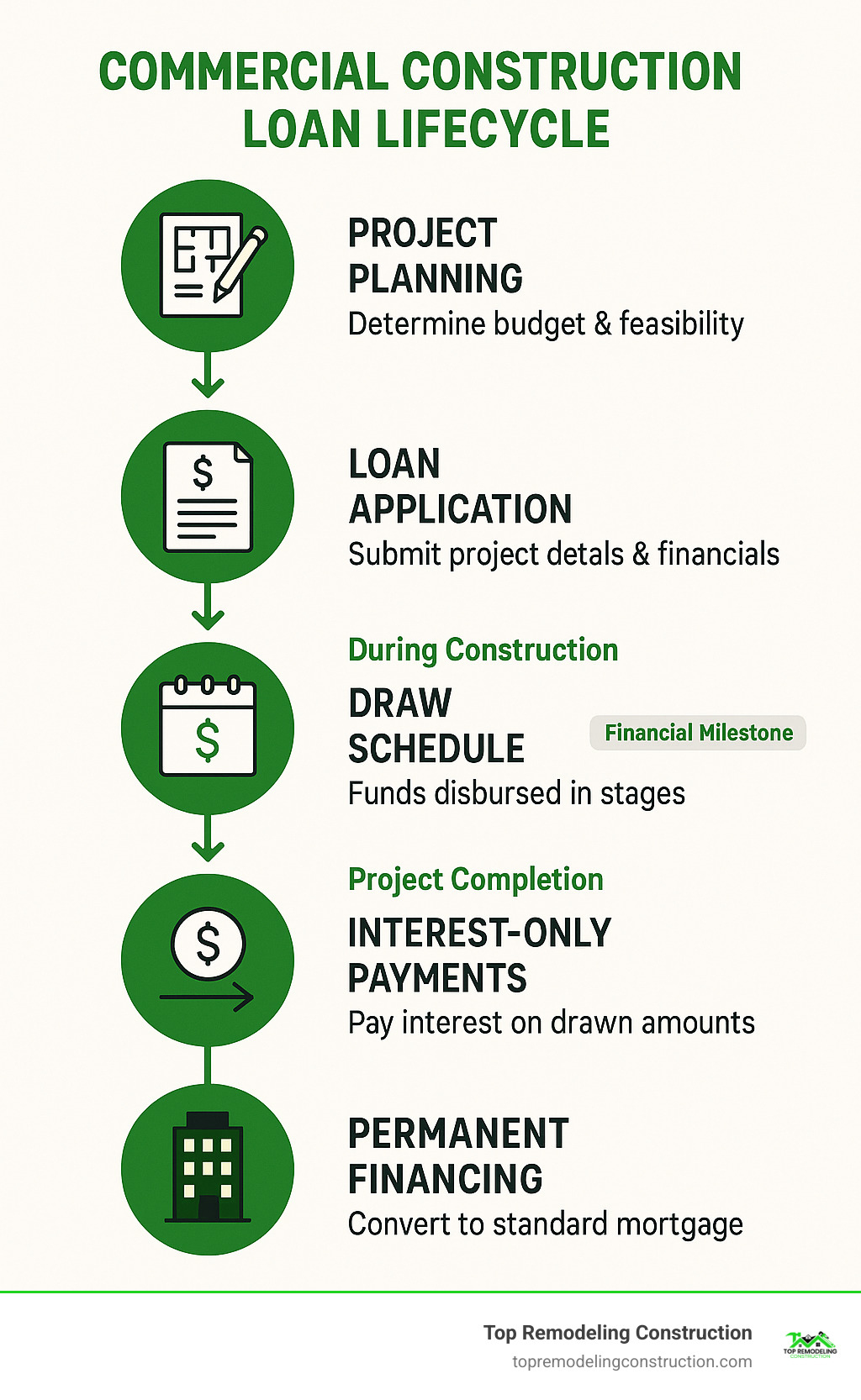
When you’re planning a major construction project, the financial complexity can feel overwhelming. Commercial construction loans work differently than traditional mortgages – they disburse funds in stages as your project progresses, charge interest only on drawn amounts, and often require conversion to permanent financing upon completion.
The stakes are high. Construction projects typically require down payments of 20-30% and involve multiple financial ratios that lenders scrutinize closely. Without proper planning, cost overruns and cash flow problems can derail even the most promising projects.
That’s where a commercial construction loan calculator becomes invaluable. It transforms complex financial scenarios into clear, actionable numbers that help you make informed decisions before you break ground.
Commercial construction loan calculator terms to remember:
- commercial construction financing
- commercial construction cost estimator
- commercial construction cost per square foot
What is a Commercial Construction Loan Calculator and Why is it Essential?
Think of a commercial construction loan calculator as your project’s financial GPS. Just like you wouldn’t start a road trip without knowing your route, you shouldn’t begin a construction project without understanding your financial journey ahead.
This specialized tool goes far beyond what a regular mortgage calculator can do. While a standard calculator assumes you’re borrowing a fixed amount from day one, a commercial construction loan calculator understands the reality of construction financing – that money gets released in stages as your project hits specific milestones.
Here’s what makes this tool absolutely essential for your success. It serves as your financial planning tool that transforms complex construction financing into clear, understandable numbers. You can test project feasibility before committing serious money. The calculator ensures budget accuracy by letting you input every detail, from land costs to permit fees.
Most importantly, it enables scenario comparison – you can ask “what if” questions about different interest rates, construction timelines, or down payment amounts. This kind of risk mitigation can save you from costly mistakes down the road.
The calculator empowers developers by visualizing loan options in a way that makes sense. Instead of drowning in spreadsheets and formulas, you get a clear picture of what each financing choice means for your bottom line. More info about commercial construction financing
How this tool helps businesses and developers
When you’re sitting across from a lender, confidence matters. A commercial construction loan calculator gives you that confidence by enabling informed decisions based on solid numbers, not guesswork.
This preparation becomes your secret weapon during lender negotiations. Banks respect borrowers who understand their numbers inside and out. When you can discuss loan-to-cost ratios and debt service coverage with authority, you’re more likely to secure favorable terms.
The calculator transforms budget management from a stressful guessing game into a strategic process. You’ll know exactly when you’ll need funds and how much each phase will cost. This leads to better cash flow planning – no more scrambling to cover unexpected expenses or wondering if you’ll have enough money to finish the project.
Comparing loan offers becomes straightforward when you can input different terms and see the real impact on your monthly payments and total costs. What looks like a small difference in interest rates might translate to thousands of dollars over the life of your loan.
The benefits of using a calculator for financial planning
The magic happens when you move from rough estimates to accurate estimations. A good commercial construction loan calculator provides total cost visibility – you’ll see not just the loan amount, but the complete picture including all interest and fees.
Interest calculation during construction loans can be tricky since you’re only paying interest on funds already drawn. The calculator handles this complexity for you, showing exactly how much you’ll pay during the interest-only construction phase versus the permanent financing phase.
This comprehensive view helps you avoid avoiding surprises that can derail projects. Construction loans often involve balloon payments or conversion requirements that catch inexperienced borrowers off guard. With proper calculation, these become planned milestones rather than financial shocks.
Strategic budgeting becomes possible when you understand the true cost of your financing. You can allocate resources more effectively, plan for contingencies, and ensure your project stays profitable from start to finish.
How to Use a Commercial Construction Loan Calculator: A Step-by-Step Guide
Using a commercial construction loan calculator might seem intimidating at first, but it’s actually quite straightforward once you know what information to gather. Think of it like following a recipe – the secret is having all your ingredients ready before you start cooking!
The process breaks down into three simple phases: gathering your project data, entering it into the calculator, and interpreting the results. We’ve guided countless clients through this process, and we can tell you that spending time upfront to get accurate numbers will save you headaches (and money) later.

Key inputs for your commercial construction loan calculator
Before you touch that calculator, you’ll need to gather some essential information about your project. Don’t worry if you don’t have exact numbers yet – good estimates will give you a solid starting point.
Start with your Total Project Cost, which includes absolutely everything from dirt to doorknobs. Next, you’ll need your Land Acquisition Cost – whether you’re buying the land or already own it, use its current market value.
Your Hard Costs are the tangible construction expenses like materials, labor, and equipment. These are usually the easiest to estimate because they’re the physical building blocks of your project. Then come the Soft Costs, which many people forget about but can really add up. We’re talking permits, architectural fees, legal costs, and those inevitable contingencies that save projects when surprises pop up.
You’ll also need to know the Loan Interest Rate you’re expecting to pay. Construction loans often have variable rates, so ask your lender for current estimates. The Loan Term is typically one to five years for the construction phase, and your Down Payment will usually be 20-30% of the total project cost.
Finally, estimate your Construction Period in months. Be realistic here – rushing leads to mistakes, but dragging things out costs money in interest payments. Learn more about estimating costs
Understanding the typical outputs and results
Once you’ve fed all that information into your commercial construction loan calculator, it’s going to spit out some very useful numbers. Let’s break down what each one means for your project.
Your Monthly Payments during construction will typically be interest-only payments that start small and grow as more money is drawn from the loan. This is different from a regular mortgage where you pay the same amount each month from day one.
The Interest-Only Payments section shows exactly what you’ll pay in interest during the building phase. Since you’re not paying down the principal yet, every dollar goes to interest. The Total Interest Paid gives you the big picture of what this loan will cost you over its entire life.
Your Total Loan Cost combines the money you’re borrowing with all the interest you’ll pay, giving you the true cost of financing your project. The Amortization Schedule is like a roadmap showing how your payments will work once you convert to permanent financing.
Many commercial construction loans end with a Balloon Payment – a large final payment of the remaining principal. This isn’t necessarily bad, especially if you’re planning to refinance or convert to a permanent loan.
Finally, the Loan-to-Cost (LTC) Ratio shows lenders how much of your project they’re financing versus how much you’re investing. Most lenders prefer to stay around 75-80% LTC, so this number helps you understand if your down payment is sufficient.
Interpreting Your Results for Smarter Project Management
Once you’ve run the numbers through your commercial construction loan calculator, you’re holding a treasure map of financial insights. But here’s the thing – those numbers are only as valuable as your ability to interpret them and put them to work. Think of this stage as translating raw data into actionable strategy that will guide your project from groundbreaking to grand opening.
The results from your calculator aren’t just academic exercises. They’re the foundation for every major decision you’ll make moving forward. Whether you’re determining if your project is financially viable, preparing for lender meetings, or managing cash flow during construction, these numbers will be your North Star.

Using calculator results to negotiate with lenders
Walking into a lender’s office with calculator results in hand is like bringing a well-organized financial playbook to the game. Lenders speak in ratios and percentages, and your commercial construction loan calculator outputs give you fluency in their language.
The Debt Service Coverage Ratio (DSCR) is probably the most critical number on your lender’s mind. This compares your project’s expected income to its debt payments. Most lenders want to see a DSCR of at least 1.25, meaning your project can cover its debt obligations with room to spare. When your calculator shows strong cash flow projections, you’re demonstrating that your project isn’t just a dream – it’s a profitable reality waiting to happen.
Your Loan-to-Value (LTV) ratio tells lenders how much skin you have in the game. Commercial projects typically need LTV ratios between 60-80%. The lower this ratio, the less risky you appear to lenders. It’s like showing them you’re so confident in your project that you’re willing to invest heavily in its success.
Financial preparedness shines through when you can discuss these ratios confidently. You’re not just asking for money – you’re presenting a well-researched investment opportunity. This level of preparation often translates into securing favorable terms, whether that’s a lower interest rate, more flexible repayment schedule, or reduced fees.
How the interest-only period impacts your project’s cost
The interest-only period during construction is both a blessing and something that requires careful planning. During the build phase, you’re only paying interest on the funds that have been drawn so far. This creates lower initial payments that help with cash flow management when your project is spending money but not yet generating revenue.
Here’s where it gets interesting: as construction progresses and more funds are drawn, your interest-only payments gradually increase. Your commercial construction loan calculator shows you this progression step by step. You might start with modest payments covering interest on just the land cost, then watch them grow as you draw funds for foundation work, framing, and finishing.
The real eye-opener comes when you see the total interest calculation over the entire construction period. Since you’re not paying down any principal during construction, every dollar of interest is pure cost. This is why understanding the numbers upfront is so crucial – there are no surprises when your monthly statements arrive.
Once construction wraps up, most loans convert to permanent financing where you start paying both principal and interest. This transition can feel like a financial gear shift, so planning for it early keeps your cash flow smooth. Some developers even set aside funds during construction to ease this transition.
The beauty of using a calculator is seeing how different construction timelines affect your total costs. A six-month delay doesn’t just push back your opening date – it adds six months of interest-only payments to your project’s total expense. Explore government-backed loan options like the SBA 7(a) which can offer more favorable terms for owner-occupied commercial construction projects.
Key Differences and Important Loan Terms
When we work with clients on commercial construction projects, one of the most common misconceptions we encounter is thinking that construction loans work just like regular home mortgages. The truth is, they’re as different as building a custom office complex versus buying a house that’s already standing. Understanding these differences isn’t just helpful – it’s absolutely essential for your project’s success.
| Feature | Commercial Construction Loans | Standard Residential Mortgages |
|---|---|---|
| Loan Structure | Funds disbursed in stages (draws) | Lump sum at closing |
| Funding Process | Tied to construction milestones | Single disbursement |
| Repayment Terms | Interest-only during construction, then converts | Principal + interest from day one |
| Risk Assessment | Based on project plans and future value | Based on existing property value |
Why a commercial construction loan calculator is different from a standard mortgage calculator
Here’s where things get interesting – and why a commercial construction loan calculator is so much more sophisticated than the mortgage calculator you might have used for your home.
Think about it this way: when you get a regular mortgage, the bank hands you a check for the full amount on closing day, and you start making the same payment every month. But construction loans? They’re more like a carefully choreographed dance.
Draw schedules are the heart of how construction loans work. Instead of getting all your money upfront, funds are released as you hit specific milestones – foundation poured, framing complete, roof installed. This protects both you and the lender, ensuring money is only released as real progress happens.
The interest calculation on disbursed funds is where many people get surprised. You’re only paying interest on the money you’ve actually received, not the full loan amount. So your first payment might be based on just the land cost, while your final construction payment could be on 80% of the total project cost.
This creates variable balances that change monthly as construction progresses. A standard mortgage calculator can’t handle this complexity, but a specialized construction loan calculator tracks these changes seamlessly.
Many projects use construction-to-permanent financing, where your construction loan automatically converts to a permanent mortgage when building is complete. This eliminates the hassle and cost of getting a second loan, but it requires different calculations for each phase.
The project-specific inputs make these calculators incredibly detailed. While a mortgage calculator might ask for loan amount, rate, and term, construction calculators need to know about hard costs, soft costs, construction timelines, and draw schedules.
Essential definitions every borrower should know
We’ve learned that speaking the same language as your lender makes everything smoother. Here are the key terms that come up in every commercial construction loan conversation:
Amortization is simply how you pay off your loan over time with regular payments that cover both principal and interest. Most permanent loans work this way, though construction loans typically don’t amortize during the building phase.
A balloon payment is a large final payment due at the end of your loan term. Many commercial loans use this structure to keep monthly payments manageable, but you need to plan for that big payment or refinancing.
Your draw schedule is your roadmap for accessing funds. It’s predetermined and tied to specific construction milestones. Each draw typically requires an inspection to verify work completion before funds are released.
An interest reserve is money set aside from your loan to cover interest payments during construction. This is especially helpful when your project isn’t generating income yet but you still need to make loan payments.
Loan-to-Cost (LTC) compares your loan amount to your total project cost. Most lenders cap this at 75-80%, meaning you’ll need significant cash or equity to cover the difference.
The Debt Service Coverage Ratio (DSCR) measures whether your completed project will generate enough income to comfortably cover loan payments. Lenders typically want to see a DSCR of 1.25 or higher, meaning your income exceeds debt payments by at least 25%.
Understanding hard costs versus soft costs is crucial for accurate budgeting. Hard costs are the obvious ones – materials, labor, and equipment. Soft costs are everything else: permits, architectural fees, legal costs, insurance, and financing fees. These soft costs often surprise first-time developers with how quickly they add up.
Frequently Asked Questions about Commercial Construction Loans
When we work with clients on commercial construction projects, the same questions come up again and again. It’s completely natural – these loans are complex, and understanding the details can make the difference between a smooth project and a financial headache. Let’s tackle the most common concerns we hear.
What are typical interest rates and terms for commercial construction loans?
The world of commercial construction loan rates is quite a bit different from what you might expect with a home mortgage. Interest rates typically range from 2.2% to 18% – yes, that’s a wide spread, and there’s a good reason for it. Commercial construction loans are considered riskier than standard mortgages because you’re building something that doesn’t exist yet.
Several factors influence where you’ll land in that range. Your personal and business credit scores play a huge role, especially for smaller projects. The type of property you’re building matters too – a simple warehouse might get better rates than a complex mixed-use development. Your experience with similar projects can also work in your favor.
Loan terms are typically short, ranging from 1 to 5 years for the construction phase. This isn’t like a 30-year mortgage – these loans are designed to get you through the building process, then you’ll either refinance into permanent financing or face a balloon payment. The specific term depends on your project’s complexity and timeline.
Market conditions also play a significant role. When the economy is strong and construction is booming, rates might be higher due to demand. During slower periods, lenders might offer more competitive terms to attract quality projects.
What are the limitations of a commercial construction loan calculator?
Here’s something we always tell our clients: a commercial construction loan calculator is an excellent starting point, but it’s not a crystal ball. Think of it as a sophisticated estimate rather than a guarantee.
The biggest limitation is that these calculators work with the information you give them, and they can’t account for every variable. They typically focus on principal and interest calculations but might miss some of the additional costs that can add up quickly. Things like origination fees, appraisal costs, environmental reports, and various closing costs can significantly impact your total project budget.
Market conditions change rapidly, and what looks good today might be different next month. Interest rates fluctuate, and construction costs can vary based on material availability and labor markets. The calculator gives you a snapshot based on current assumptions.
Every lender also has their own unique approach to underwriting and risk assessment. Some might offer better terms for certain types of projects, while others might have stricter requirements. A generic calculator can’t replicate the detailed analysis that each lender performs.
Most importantly, professional advice is still essential. While these calculators are fantastic planning tools, they’re not substitutes for sitting down with an experienced loan officer who can walk you through the specific requirements and options available for your unique project.
What key ratios do lenders evaluate for commercial construction projects?
When lenders look at commercial construction projects, they’re essentially trying to answer one question: “Will this borrower be able to pay us back?” To answer that, they dive deep into several financial ratios that paint a picture of both the project’s viability and your ability to manage it successfully.
The Loan-to-Value (LTV) Ratio is often the first thing they calculate. This compares the loan amount to what the completed property will be worth. Most commercial construction lenders prefer LTVs between 60-80%, meaning you’ll need to bring at least 20-40% of the project cost as your down payment or equity contribution.
The Debt Service Coverage Ratio (DSCR) is equally critical, especially for income-producing properties. This ratio looks at your project’s expected net operating income compared to the debt payments. Lenders typically want to see a DSCR of 1.25 or higher, which means your property should generate 25% more income than needed to cover the loan payments.
Your personal and business credit scores carry significant weight, particularly for smaller loans under $350,000. Most lenders require a minimum personal credit score of 660, though 680-700+ will put you in a much stronger position for better terms.
Business history matters too. Lenders prefer working with businesses that have been operating for at least two years, showing stability and a track record of generating revenue. They’ll want to see detailed financial statements and tax returns to verify your business’s financial health.
The beauty of understanding these ratios ahead of time is that you can work to improve them before applying. Whether that means increasing your down payment, improving your credit score, or adjusting your project scope to improve the projected income, knowing what lenders look for puts you in control of your financing destiny.
Conclusion: Build Your Project on a Solid Financial Foundation
Starting on a commercial construction project feels like standing at the edge of something amazing – and honestly, a little scary too. The numbers are bigger, the stakes are higher, and one wrong financial move can turn your dream project into a nightmare. But here’s the good news: you don’t have to steer this journey blindfolded.
A commercial construction loan calculator isn’t just another boring financial tool gathering digital dust on some website. It’s your financial compass, guiding you through the complex world of construction financing with clarity and confidence. Think of it as having a crystal ball that shows you exactly what your project will cost, how much you’ll pay monthly, and when those payments will hit your bank account.
Throughout this guide, we’ve walked you through everything from understanding draw schedules to interpreting balloon payments. We’ve shown you how to input your project costs accurately and how to read the results like a pro. Most importantly, we’ve equipped you with the knowledge to walk into any lender’s office with confidence, armed with solid numbers and a clear understanding of your project’s financial landscape.
The beauty of proper financial planning is that it transforms uncertainty into opportunity. When you know your numbers inside and out, you can negotiate better terms, avoid cash flow crunches, and sleep better at night knowing your project is built on rock-solid financial ground.
At Top Remodeling Construction, we’ve seen how proper planning makes the difference between projects that soar and those that struggle. As a family-owned business, we understand that every project represents someone’s vision, hard work, and financial investment. That’s why we’re passionate about helping you get the financial foundation right from day one.
Our attention to detail doesn’t just apply to the physical construction – it extends to understanding the financial side of your project too. We know that when the numbers work, everything else falls into place more smoothly. Your project gets completed to your exact specifications, on time and within budget.
Ready to turn your construction vision into reality? Let’s build something amazing together.
Partner with expert building contractors for your next project

