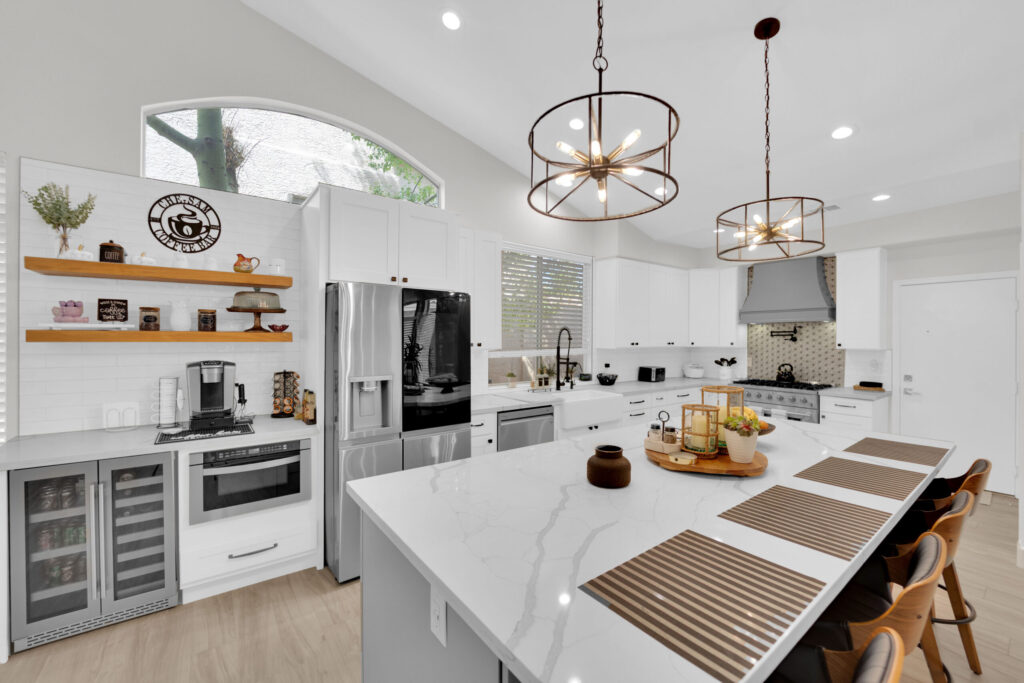
Quick Answer: Good kitchen lighting is never one bright fixture in the middle of the ceiling. It is three layers, ambient, task and accent, working together so the room adapts naturally from early morning coffee to meal prep to a relaxed evening. Getting the layers right changes how a kitchen feels far more than most homeowners expect.
Walk into almost any older kitchen and you will find the same setup: a single ceiling fixture doing all the work. It floods the room with flat, even light and somehow still leaves the countertop in shadow every time someone leans over to chop an onion. That is not bad luck, it is physics. A single overhead source cannot do the job of three different kinds of light.
Why One Ceiling Light Never Feels Right
A kitchen is asked to perform more roles than almost any other room in the house. It needs bright, even light for cooking, focused light for fine detail work, softer light for entertaining, and low light for a midnight glass of water without flipping on every switch in the room. No single fixture can flex across all of those moods.
Lighting designers solve this with layering, treating light as three separate systems that get planned and controlled independently rather than one job handed to one fixture.
The Three Layers, Explained
| Layer | Purpose | Common Fixtures |
| Ambient | Fills the whole room evenly so no corner feels dim or flat | Recessed cans, flush mounts, or a central fixture sized to the room |
| Task | Lights the exact surface where work happens, cutting shadows from your own body | Under cabinet strips, pendants over an island, a fixture above the sink |
| Accent | Adds depth and mood once the sun goes down, and shows off design details | Puck lights in glass cabinets, toe kick lighting, LED strips on open shelving |
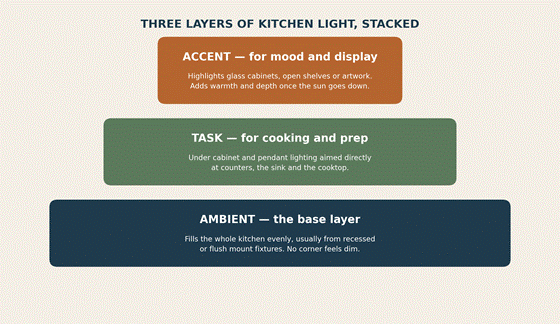
The mistake most kitchens make is relying almost entirely on the ambient layer and skipping the other two. The fix is rarely about adding more light overall, it is about placing the right kind of light in the right spot.
Color Temperature: The Detail Homeowners Miss
Beyond brightness, the color of light itself changes how a kitchen feels. Light is measured in Kelvin, and kitchens tend to work best somewhere in the middle of the range rather than at either extreme.
| Kelvin Range | How It Feels | Best Used For |
| 2700K to 3000K | Warm and cozy, similar to old incandescent bulbs | Gathering areas, pendant lights over an island, evening ambiance |
| 3500K to 4000K | Bright, clean and neutral | Task lighting over counters and the sink where detail work happens |
| 5000K and above | Crisp, energizing, closer to daylight | Rarely ideal for kitchens, can feel clinical rather than inviting |
Mixing temperatures within the same kitchen, even between layers, is one of the most common lighting mistakes. A warm pendant over an island paired with cool white under cabinet strips can make a beautifully designed kitchen look unfinished.
Layering by Activity, Not Just by Room
Once the three layers exist, the real payoff is control. A well-planned kitchen lighting scheme lets each layer be adjusted on its own, which means the same room can shift moods without any construction at all.
- Morning coffee: soft ambient light only, nothing harsh this early
- Weeknight cooking: ambient plus full task lighting over every work surface
- Entertaining: ambient dimmed low, accent lighting doing most of the work
- Late night snack: accent lighting alone, enough to see without waking the house
Natural Light and Smart Controls
Layered lighting also has to account for the light already coming through the windows. A kitchen that feels perfectly lit at noon can feel dim and yellow by evening if the artificial layers were not planned with that shift in mind. Dimmers and smart controls on each layer make it possible to compensate throughout the day instead of settling for one fixed setting.
Energy efficient LED fixtures also make layered lighting far more practical than it used to be, since running three separate systems no longer means three times the electricity use. Our eco-friendly kitchen remodel guide covers more on efficient lighting choices.
Browse our completed kitchen projects to see layered lighting in action across a range of Las Vegas kitchens.
Frequently Asked Questions
Do I need an electrician to add lighting layers?
In most cases, yes, especially for new circuits, under cabinet wiring or recessed can additions. A licensed contractor can plan the wiring alongside any other kitchen work being done.
What is the biggest lighting mistake homeowners make?
Relying entirely on ambient lighting and skipping task lighting over the counters and sink, which is exactly where bright, shadow-free light matters most.
Should every layer be on the same dimmer?
No. Each layer works best on its own switch or dimmer so it can be adjusted independently based on the activity happening in the kitchen.
Can layered lighting work in a small kitchen?
Yes. Even a small kitchen benefits from separating ambient, task and accent light, it often just means fewer fixtures per layer rather than skipping a layer altogether.
Ready to Rethink How Your Kitchen Is Lit?
Top Remodeling Construction plans lighting as part of every kitchen remodel, not an afterthought. Call (702) 538-1979 or request a free quote to talk through a lighting plan that fits how your kitchen is actually used.